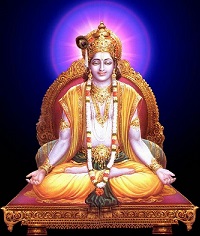
The Mahabarata war of Kuruksetra is to begin. The great saint and seer Vedavyasa appears in the court of Drutarastra, the king of Kauravas and tells him that he would give him the divine power to see the fight going on far away in the battle field of Kuruksetra. But the king denies the offer. Giving the divine power to Sanjaya, the king's loyal champion, Vedavyasa leaves the court. Sanjaya also leaves the king, giving him a general description of the war.
The term yoga refers to the union of individual soul (unit self) with the Supreme (Paramatma). The Seers, the wise and the devotees of God incessantly try to attain the state of communion of their souls with the God, the Supreme consciousness. Those who try for the communion of soul by acquiring right knowledge of the Paramatma (Supreme) are called the Sankhya. Sri Krisna tries to reveal the secret of Sankhya yoga in this chapter. We are fortunate enough to know it through the discussions of Arjuna and Sri Krisna.
The important methods of yoga are Karma yoga and Janana yoga, though there are other ways such as Bhakti yoga(Yoga of devotion), Samnyasa yoga(yoga of total surrender), Karma Samnyasa yoga etc. We know that all the developments of human society are based on karma(action). Even our life on earth is to do action. It is stated that the ultimate aim of our birth is to attain God, after shaking off all bondages, being attributed to our karma. Karmapasa is the bondage preventing us from realizing God and uniting with Him.
There seldom exists right knowledge or right action alone. Right action and right knowledge are jointly called JnanaKarmayoga. Samnyasa refers to one's total surrender to God.The way by which one can lead to a peaceful life, surrendering himself to God is discussed in this chapter. What is important is yoga i.e. the union of soul with the God. The ultimate goal of every soul is its communion with the Supreme consciousness.
Actions are performed with the help of sensory and motor organs and the mind. But the question is how an action affects a person; positively or negatively. Negative or positive impact of the action on individuals brings bondage to one's soul. Action bringing bondages to one's atma (soul) are not desirable. Karma samnyasa yoga stands for, internally surrendering the fruits of action unto the God, so that the atma shall not be affected by the bondages formed by actions.
The words 'Atma samnyama' refer to the control of one's mind. It looks for as to how mind can be withdrawn from sense objects and can be directed towards the Supreme. A man's mind is generally filled with a number of thoughts, positive and negative. 'Dhyana' refers to meditating upon God the infinite love and consciousness. It is the true dhyana or meditation.Naturally all the thoughts are related to mundanities and attached to sensual desires.
Jnana refers to the overall or complete knowledge. The analytical knowledge is called vijnana; specific knowledge. For example a peepal tree is usually very big and shady. The knowledge regarding the particular family of the tree, the quality and nature of the leaves, the possible age of the tree, the structure and nature of the roots etc; refers to vijnana or analytical knowledge. Jnana in Bagavad Gita stands for the knowledge of the Supreme, the formless and attribute less Divinity.
The term 'Akshara' refers to the imperishable and everlasting one. Imperishable one is Paramatma, the Supreme entity. It is the infinite without beginning or end. 'Kshara Brahma' is the one being formed and getting changed into enumerable perishable forms. There are two other classifications of Brahma; Nirguna Brahma and Saguna Brahma. Nirguna Brahma is a state of Supreme consciousness (God) without the influence of Prakriti, the natural forces.
The term Rajavidya or Rajayoga refers to the noble yoga or the great yoga method. Guhya refers to the secret of yoga. Yogavidya is great and secret. It is imparted by great masters or Gurus to their disciples directly and secretly. There cannot be any agent to a great Guru. All are not eligible to practice yoga vidya. The eligibility is to be attained by a certain level of purification of one's mind. It is the minimum qualification required for imparting Yoga vidya to an aspirant.
Vibuthi refers to God's qualities and bounties. In this chapter there is a detailed discussion of Parmatma's powers, qualities, gifts, glories etc. There are many who worship God as power and wish to attain power. They worship God for material gains. But there are a very few who worship God as the ultimate truth responsible for all material and immaterial manifestations. They consider God as consciousness, the owner and the controller of all powers.
The Lord, Sri Krisna has revealed the secret of the universe and spirituality, also about the power of the human mind and its helplessness etc. through the ten previous chapters (I-X). But Arjuna was not fully convinced. Therefore Sri Krisna was compelled to give Arjuna the vision of his universal person making him ready for the performance of his moral obligation to fight against Kauravas.
Bhakti refers to the ardent reverence to some person, concept or God. A pious man is simple and humble and not necessarily be a scholar; and that a scholar (jnani) need not be a pious devotee (Bakta). A wise scholar tries to remove all his doubts in the path of spirituality by logic and reasoning and by acquiring knowledge. But a pious devotee of God is unconcerned with such knowledge, as he has already surrendered everything unto God.
Ksetra refers to a particular realm or plane (Mandalam). It is to be understood as a place of worship. He who knows about Ksetra is Ksetrajna. Many of us conduct our worship in temples where images (idols) of Gods are consecrated for worship. Some worship their selected images of Gods in private prayer rooms at their homes. Some others worship God chanting His name always secretly.
Gunathraya refers to the operating principles of Prakriti .Sattva guna (Sentient force), Rajo guna (mutative force) and Tamo guna (static force) the forces constituting Prakriti. 'Siva Saktiatmakam Brahma', means that consciousness and power together constitute Brahma. In Nirguna Brahma the forces of Sattva, Raja and Tama are dormant and not active. There the Supreme consciousness alone is felt and experienced by the purified individual soul.
Parmapurusa (Supreme consciousness) is Purushotama. The process of attaining Purushotama is Purushotama yoga. It is the most desirable and greatest of all yoga practices. The aim of a true spiritual aspirant is to attain Paramapurusa who is beyond the purview of the forces of Prakriti. The Purusa is Omnipresent, Omnipotent and Omniscient. It is a process to attain or become one with the Supreme Purusa.
The terms 'Div' refers to light and the term divine is related to it. Therefore Deva or God means the divine (light). The opposite word of Deva is Asura which means darkness or ignorance. Asuras are those who stand against virtue and virtuous persons. They are negative in character. Those with divine qualities march towards the Supreme light while those who with Asura qualities move only all along darkness or ignorance. People of Asura qualities make all the troubles to those with virtues.
Sradha refers to one's belief and faith and 'thraya' to the three forces of Prakriti. The minds of individuals can be categorized into three on the basis of the intensity of the influence of the forces (gunas) of prakriti in them. They are Sattvika, Rajasika and Tamasika. If an individual's mind is dominated by Sattva guna rather than Rajo guna and Tamo guna he is said to be Sattvika. Where Rajo guna is dominant, he is called Rajasika and Tamasika in whom Tamo guna is the dominating force.
The term 'moksha' refers to the liberation of one's soul from his mind which is under the grip of the forces of Prakriti. Nyasa stands for the surrender. Total surrender to God is samnyasa. Once the ego, the mind and the intellect of a person are surrendered unto the Supreme; it is said to be samnyasa. It helps to liberate one's self from the operative principles of Prakriti. The forces of Prakriti in one's mind torture the soul continuously and that the soul intensely desires for the liberation or total freedom from the mind.