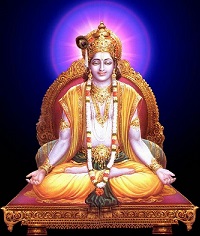
Bhakti refers to the ardent reverence to some person, concept or God. A pious man is simple and humble and not necessarily be a scholar; and that a scholar (jnani) need not be a pious devotee (Bakta). A wise scholar tries to remove all his doubts in the path of spirituality by logic and reasoning and by acquiring knowledge. But a pious devotee of God is unconcerned with such knowledge, as he has already surrendered everything unto God. A wise scholar observes and analyses everything very keenly and carefully for convincing himself of the facts. A Bhakta (pious devotee) is more peaceful and one who has established his thoughts constantly upon the Supreme. It is said that a pious devotee attains the realization of God soon and gets liberation much earlier than a wise devotee. A Bhakta has no doubt. He sees God in everything and everything in God. The mundane life of a Bhakta is considered a failure by many. But in the realm of spirituality and self-satisfaction he is much superior to anybody else. A pious devotee is very dear to God as he has no confusion to the right direction of his path.
Arjuna said: The devotees worship you in two ways. Some by fixing their minds on you, worship you in the forms according to the attributes of their minds. But others worship you as the formless infinite consciousness. Among these groups who are the best knowers of the Supreme? The Devotees worship God as formless and infinite and other desired forms. Actually God is infinite and formless. But still devotees worship God in particular forms. Yogis opine that it is easy to worship and visualize forms representing the Supreme. According to them form worship and meditation give them soothing attention and comforts to the devotees. To worship the Supreme meditating upon the formless and the infinite consciousness is not easy. It is stated that form worship helps one to realize the Supreme more easily than worshipping the formless.
Krisna said: Fixing the mind on Me, those worship Me in the right form with deep faith are superior than those worshipping Me in my formless and infinite ideation. Form worship is symbol worship. In symbol worship, the devotees mind can be arrested and directed towards the subtle and ideational realms. Their minds move from symbol to the idea and from idea to symbol. Form in the psychic level is not material but is a condensed form of an idea. Form worship is a secret way of worshipping God. It is an easiest technique of worship leading to the realization of God. Formlessly worshipping the infinite Supreme consciousness is comparatively difficult. Therefore a spiritual aspirant should select a proper symbol according to his interest. The symbols selected shall be able to generate positive thoughts in the devotees, directing their minds towards the Supreme consciousness and not towards the Supreme power. Power worshippers are not spiritualists. They are actually materialists and their minds move in the wrong and opposite direction of spirituality.
However those worshipping Me in My formless and infinite status, controlling the senses with equanimity and for the welfare of all; shall also reach me in due course. Brahma worship is characterized by the worship of the formless, all pervading, beyond the influence of maya (illusion), perfect and beyond words. Brahma worshippers are also knowledgeable persons and will attain God. 198 Worshipping God without form is very rare. Form worship is found to be easy and simple.
Worship of the formless is really difficult because the un-manifest is not easy to be realized. The great devotees or jnani prefer worshipping the formless to satisfy their knowledge and conviction.
However those performing all actions surrendering unto Me and worship Me with single minded devotion shall be delivered from miseries of births and deaths. Either the form worship or the formless worship; it is immaterial. One must do every action surrendering to God, by which bondages are removed and finally the soul would be released and it can fly like a swan up and up above, entering into the eternity.
Try to fix your mind on Me and there by establishing your intellect in Me alone; you can verily reach Me. But if you cannot fix on Me single mindedly you can do it by the practice of yoga. Though it is difficult to bring your senses under control, if you have a determinate will it is possible.
If you are not able to do the practice of yoga you shall do all right actions fixing your mind on Me. You can attain the Supreme even by doing all actions surrendering unto God. It is yoga of Karma. Every right action turns to be worship to God. The practice of yoga is not easy for many. They find it difficult to control their mind and senses even for a few minutes but are always engaged in actions. For them the most suitable way to get relief from bondages is to do right action taking the ideation of the Supreme by mental exercise. The aim of worship to God is to refine one’s mind and to get rid of the bondages originated from actions with a view to freeing his soul form the slavery of the mind.
If you are unable to do the yoga of meditation or do right karma with due ideation of the Supreme, you can do it by surrendering the fruits of your action unto Me so that you will be relieved from the bondages of action. It is action without desires. Nishkamakarma is doing all right action without self-interest of the fruits of action. By doing so an individual’s attachment to the fruits can be despensed with. Attachment means a bondage and consequent torture to the soul. The feeling of my and mine disappears relieving the doer in the case of Nishkama Karma. The devotees mind will become pure and clear. Nishkamakarma, i.e. without desiring for the fruits of action is a great message of Bagavad Gita to the whole world.
Real knowledge (about God) is greater than the practice of yoga. Meditation is superior to knowledge. The sacrifice of fruits of action is superior to meditation. The devotee sacrificing (renouncing) the fruits of action gets peace immediately. Knowledge and yoga practice are different. Though some do regular yoga practice they may not develop real knowledge.Their interest may be physical wellbeing. But if one tries to improve his real knowledge, it is possible to him. The practice of yoga or right action, whatever it be, unless done fixing his mind on God with devotion, no desirable benefits can be achieved. One must have due interest to know God above all. The aim of the practice of yoga shall not be confined to getting relief from illness or for physical betterment. The most important purpose of yoga is spiritual improvement and to realize God.
A devotee who has no hatred to any being, compassionate and friendly, without I and my feelings, keeping equanimity in sorrow and happiness, forgiving by nature, contented, with controlled senses and mind, surrendering his mind and reason unto Me; is dear to Me. This shows all the qualities of a true devotee of God. A devotee must be always contented or otherwise his mind will be disturbed. He must love every being equally and must be generous to others so that selfish nature would disappear. He should have control over his senses from sensual enjoyments. It requires his mind and intellect to be stable. A fickle minded person cannot do any yoga practice or anything positive and that he cannot be relied on. Love, compassion, unselfishness, right action, devotion, stability of mind etc. are the values of life one should follow.
He who does not cause any disturbance to the society, and not annoyed by the act of others and not affected by anxiety due to delight, anger or fear; is dear to Me. A yogi shall no way make any trouble to others even when those around disturb him. He shall not be over delightful and not be overcome by anger or fear. A yogi should be an ideal person.
The devotee who is without desires, pure internally and externally, wise, having no attachment to anything, rises above all disturbances and renounces the feeling of doer ship; is dear to Me.
A person with full of devotion, not rejoicing on results, not hating any being, seeing equally on desirable and undesirable results; is dear to Me.
He who remains equanimous in the dichotomic feelings of enemy and friends, honour or ignominy, cold and heat, happiness and sorrow, and remains unattached, keeping silence and fixing his thoughts on the Supreme consciousness; is dear to Me. It is said in Gita that ‘Samathvam yogamuchate’ that is equanimity is yoga.
Those pious devotees taking part in the nectar of wisdom without attachments are relieved by Me as discussed above and those devoted to Me by their unfailing faith in Me; are extremely dear to Me. In this chapter the peculiarities of devotees are discussed in detail. It is actually a subtle psychoanalysis of various types of devotees of the Supreme. A true devotee is mentally free than a wise. He has already renounced everything on God and has no desires and therefore contented. Make your mind free, unattached and enjoy the divine bliss.