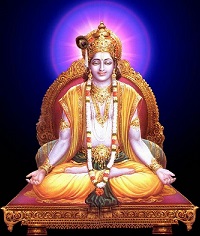
The term spirituality has been misconceived by many and so is the concept of God. Spirituality refers to the march towards the Divine consciousness and nothing else. It stands for refining one’s mind, making him humble and value oriented.
Most of the people worship God as the Supreme power. A very few regard Him as the Supreme consciousness that controls all powers. This is the concept of God as enshrined in Bagavad Gita and in most of the Eastern philosophies. But unfortunately this concept has not been well revealed by the Western philosophies. Hence there exists many a controversy, being conceptual differences.
One who is enlightened by spiritual wisdom, i.e. real knowledge, sees and loves the entire humanity equally and in unison. A power worshiper tries to gain power and to control others in every possible field. He does not know that power is only an attribute of God and that it is not God. He strives to amass wealth, power, name and fame and is very much concerned with the mundane enjoyments and pleasures. On the contrary a spiritualist leads a life, even with minimum requirements; truthfully, humbly and peacefully.
An Occultist is one who has attained some strange mental powers by certain secret psychic practices. He makes others believe that he has gained some Divine powers and that the ignorant start worshipping him as or equal to God. This is wrong and it would turn into, anti-spiritual and anti-God. A yogi is spiritual, a siddha need not be.
The Vedic concept of ‘Aham Brahmasmi’ seems to be illogical according to Bhagavat Gita; as the soul is only a small particle of the Divine self. A drop of water cannot be the ocean. When Aham (The ego) becomes nil or disappears one’s soul merges with the Supreme consciousness. The power worshipers might have misused this Vedic dictum to declare themselves as God.
The concept of Purusa is very relevant in Bagavad Gita. Purusa refers to the Supreme consciousness (The God) and Prakriti, the Supreme power. Worshipping of Purusa only is spiritual.
The entire revelations of the gospels of Bagavad Gita cling around the five principles of moral obligation (Dharma), right action (Karma), right knowledge (Jnana), freedom (Swatantrya) and peacefulness or bliss (Ananda). Man has to progress in the three fields of this existence; physical, intellectual and spiritual to become perfect. Physical and intellectual progress is necessary for his successful worldly life. But spirituality blends these two realms (physical and intellectual) harmoniously making one’s life really meaningful and successful.
Moral obligation is the duty assigned to every person on the basis of his conduct and status in the society. A student’s moral obligation is to study well while a teacher’s is to be committed to his profession. The parents’ obligation is to properly look after their children, while a social worker’s moral obligation is to stand for the welfare of the society. Thus the term moral obligation has different meanings on the basis of the respective social status of the individuals. However the ultimate duty or moral obligation of every individual is to attain total freedom of his soul.
Right action refers to the action being performed without attachment and bondages to the soul. The Atma (soul) is, a true particle of the Supreme being, present in everybody, under the control of the operative principles of Prakriti (Nature), active in his mind. The soul longs for freedom from bondages while the mind binds it again and again. Right action unties the bondages and releases the soul to ultimate freedom.
Right knowledge (Jnana) means the knowledge relating to the Supreme consciousness. Jnana according to Bhagavad Gita is the right knowledge of the Supreme and vijnana, the analytical knowledge. Thus knowledge as referred to in Gita is the knowledge of the Divine consciousness.
Freedom of the soul refers to the freedom from all bondages that prevent the soul from moving towards the Supreme Self.
Peacefulness or bliss is the ultimate state of one’s soul getting merged into the Supreme.
Yoga is the communion of the soul (unit self) with the Supreme consciousness. The practice of yoga is a sacred mental exercise imparted by a true Guru capable of leading the spiritual aspirants to attain the Supreme Self.
Faith refers to one’s belief without empirical evidences. Faith in God is not necessary to lead a peaceful social life, provided one is value oriented. But faith in the Divine Self helps one to keep his inner personality peaceful. One may realize this truth only in his later stage of life span, consequent on his life experiences.
Many of the authors, who interpreted and studied Bagavad Gita, have not well revealed the implied spiritual truths and meanings contained in it. Some consider Bagavad Gita as a guideline for the healthy social life. Yet some consider it as an effective approach to the problems of war and conflict. But Bagavad Gita covers almost all the human problems in physical, intellectual and spiritual realms and hence is comprehensive. Bagavad Gita spends most of its discussions on the psychological and spiritual aspects of human beings, mainly the conflict within the human mind. The great seer, Vedavyasa might have meant war as a continuous conflict taking place between the good and evil forces within one’s mind and in the collective mind of the society. To know the real wisdom of Bagavad Gita one must approach it with purity of mind and humbleness.
In the present study a humble attempt is made to throw some light upon the psychological and spiritual aspects of Bagavad Gita with a view to making aware the common readers the implied meanings of it. This study is made as simple as possible eliciting the core ideas of the stanzas without merely insisting on the word meanings. Brief interpretations are also given wherever found necessary. I would be satisfied if anybody finds it worth to know the real sprit of Bagavad Gita with the help of this humble attempt.
I am very much thankful to Sri K.U Udayan, Dr. E.S Rajendran, Dr.K.V Janardhanan, Sri K.C Radhakrishnan and Dr Vandana for their sincere encouragements and services rendered to me for the accomplishment of this work. I am also grateful to my beloved young friends Sri K.V Sooraj and Sri Mohit Rajan, representing the new generation for their services and help in this regard.
Sadanandan E.V
04-OCT-2017