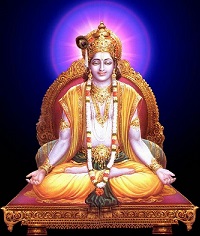
The words ‘Atma samnyama’ refer to the control of one’s mind. It looks for as to how mind can be withdrawn from sense objects and can be directed towards the Supreme. A man’s mind is generally filled with a number of thoughts, positive and negative. ‘Dhyana’ refers to meditating upon God the infinite love and consciousness. It is the true dhyana or meditation.Naturally all the thoughts are related to mundanities and attached to sensual desires. Peace of mind is disturbed as the thought waves are increasing and even overlapping continuously. When the thoughts are very few one feels more and more peace of mind. By controlling the thoughts, related to sensual objects one can get internal peace. When the thought waves subside one’s mind becomes peaceful. Yoga is easy for a peaceful mind. When thought waves are continuously generated in one’s mind, one after another or simultaneously it becomes difficult to maintain equipose of mind. By the dhyana of the Supreme consciousness in the form of love and compassion one can easily get control over his senses and mind. It is said that the unit self (soul) shall have a long pilgrimage through births and deaths until the mind becomes purified enough to be merged with the Supreme. Dhyana helps one to purify his mind.
Do meditate upon the infinite love and compassion of the Supreme consciousness and get control over your senses and make your soul free to realize and merge with the Supreme.
He who does all actions with the motive of getting fruits there from, is neither a sanyasin nor a yogi. One also does not become a samnyasin by not performing actions. A samnyasin means one who is established himself in God and surrendered everything unto Him. It is inevitable for everybody to perform certain actions or karma. Proper action is one without desiring for fruits. A person not performing any action or work is a parasite depending on others for his needs. A sanyasin is not in his form (outward appearance) but in his real mental status. Most of the modern pseudo sanyasin live luxuriously at the expense of others. They are materialists. A samyasin is one; who is without desires, loving, truthful, leads a simple life and stands for the welfare of others. Do all possible right actions submitting the fruits unto God.
Even when samnyasa and yoga are considered as the same, no one can become a yogi without giving up the intense thoughts of material pleasures. Remaining without attachment internally to material pleasures is really the state of yoga. Human mind is characterized by a spontaneous flow of sensual thoughts and desires. His mind is often like an agitated sea. Those who know the secret of dreams say that sea is an image of one’s mind. Where the desires subside one’s mind becomes deep and peaceful as a calm sea without waves. Yoga is internal peace and bliss.
He who wants to attain the highest stage of meditation, right action is said to be the cause. But he who has entered the realm of yoga peace is considered to be the cause. It is only the right action that causes one to attain the state of peacefulness and to attain the Supreme self.
When a man is unattached to the objects of senses or actions and he who has renounced all his thoughts of worldly pleasures; he is said to have mounted on the heights of yoga. One has to do actions without attachment and to do away with the desires or fruits of action to attain peace and to reach the Supreme. Thoughts related to mundanities disturb one’s mind as pleasure principle is a guiding factor of thoughts in his mind. A person who has given up the desires and fruits of action can climb up the highest level of yoga or realization.
One should progress by his right action and should not degrade himself. He should know that his own self is the friend of his soul, so also the soul’s enemy. One’s soul should be directed towards higher planes by his purified mind. No individual can exist without the soul. Mind is formed by the blind forces of Prakriti. When an individual acts against his atma it becomes weak. It is the atma that suffers the pains of the actions and enjoys the pleasures. One should purify his mind to become a friend of his soul.The self becomes a friend of the soul when one has conquered his mind, senses and body. Where one could not have control over his senses, mind and body, his self acts as an enemy. One’s lower self represents mind, senses and body. It is the lower self acting as friend or enemy of the soul. One’s soul (atma) is only a witnessing entity in him and does not do any action, though enjoys or suffers the fruits of action.
He who has control over the mind and the senses and who is peaceful, the Supreme is rooted in his knowledge. He is not affected by honour or ignominy. The pair of opposites like cold and heat, joy and sorrow also do not affect him. A person who wins the senses becomes the owner of a peaceful and serene mind.
Yogi, whose mind is seated in Jnana and vijnana and remains unmoved under any of the situations; who’s sense are controlled and who sees no difference among earth, stone and gold; is a God realized soul. Jnana refers to the knowledge of God (perfect knowledge) and vijnana the analytical knowledge. The knowledge about the manifest world is vijnana and of the Supreme, the unmanifest, is Jnana. He who knows both Jnana and vijana will remain stable and unmoved. He shall gradually attain oneness with Supreme. Earth is more useful than stone or gold because earth helps for maintaining our lives.
He who sees his well-wishers, friends, foes, mediators, relatives and the objects of hatred with equanimity of mind is of a balanced intellect and stands great. A man with the balanced intellect shall feel the presence of God everywhere and recognizes that the same soul is present in everybody. He who knows that the Ultimate truth shall not have hatred or unfriendliness to anybody really enjoys the Supreme love.
A yogi who has controlled his senses and mind and who is free from possessions and desires, living in seclusion shall continuously meditate on the Supreme. One who has control over his mind and senses shall meditate upon the Supreme in solitude. A collective prayer is not yoga. Deep meditation is not generally possible in a collection of persons or groups. Ideational unity cannot be attained in collectivity. It is because the mental vibrations of different persons are different. But collective prayers have some other benefits. Meditation is individualistic and should be done in seclusion.
The proper place (spot) for meditation is a clean place where kusa grass grows. A deer skin spread on the grass and a cloth upon it, a place neither very high nor very low is suitable for mediation. Meditation requires a calm and clean place. A place covered with kusa grass (a particular glass), placing a deer skin on it and there upon a cloth spread is said to be ideal for mediation. Instead of deer skin, tiger skin is also used. Some prefer tiger skin because it removes the fear complex if any. While performing meditation electronic waves are produced in the body, a nonconductor like a deer skin or tiger skin is found to be good. But time passed. The wild animal’s skin is forbidden by law. Even without this, meditation is possible and the union will also take place. The basis is the mind. Meditation is to be performed seated in a proper place controlling the mind in seclusion. This shall be intended for the purification on one’s mind. Meditations taking true ideation of the God (Supreme love or Supreme consciousness) can only purify one’s mind. If one meditates God as supreme power it would inevitably bring bondage of desires aggravated by the ideation of power. Purification of mind and realization of God is possible only by meditating upon the Supreme beyond all powers or the forces of Prakriti. Purusa (consciousness) is God.
Keeping the trunk of one’s body, head and neck straight and calm, fixing the mind on the tip of the nose without looking to any other direction and remaining fearless with chastity and controlling the mind, absorbed in the thoughts of Me (God), he can enter into deep meditation. A Comfortable seat and posture are desirable. Before starting meditation first a proper seat and then purity of mind are insisted. ‘Sukha Stira Assana’ i.e. the most confortable seat is preferred. One must do meditation consciously. There are many instances of one falling into his unconscious without control over the conscious part of the mind. It is not advisable to go into the unconscious state without having control over one’s mind. It is harmful too. Meditation shall not be performed speedily. It must be calm and slow. Do not perform meditation under the pressure of anybody. Perform meditation in a calm and secluded place, if possible, and be always conscious during meditation.
Arjuna, this yoga is not for he who over eats or who does not take adequate food, or observes severe fasting or sleeps too much or dreams much or he who remains awake without proper sleep. A yogi must take only the necessary food to maintain his body. If one takes more food it will lose his presence of mind while performing meditation. Those whose minds are engaged in fantasy (daydreams) cannot do meditation. A very normal person performing his day to day functions properly and systematically alone is qualified to do the right action of meditating on God.
Yoga can be accomplished only by he who is regulated by proper food, dreams and emotional equilibrium and performing right actions. He must also be disciplined by proper sleep and awakefulness.
When one’s mind is controlled and thoroughly focused on God then he gets himself free from the craving of sensual enjoyments. He is said to be established in the Supreme. To focus oneself on God, control over the senses and mind are necessary. One’s soul is under the pressure of bondages caused by the forces of Prakriti.
As the flame of a lamp remains unaffected at a windless place, the mind of a yogi shall remain calm and still while practicing yoga. The flame of a lamp remaining undisturbed in a windless environment is very much soothing and apt to explain the beauty and calmness of the mind of a yogi. The internal vision of such a flame is said to represent one’s soul. The greatness of one’s mind depends upon his peacefulness and not in the use of luxuries in life.
When one’s mind is purified and becomes still by the practice of yoga, having realized the Supreme; remains in Him rejoicing. Purification of one’s mind is a prerequisite for realizing the supreme. Impurities of one’s mind refer to the bondages of the soul. As the mind becomes pure and purer the soul gets nearer to the Supreme.
A Yogi who experiences bliss beyond his senses by purified and subtle intellect, moves speedily towards the Supreme consciousness. The Supreme bliss can be experienced by a purified intellect and not by senses. The so called yogi or gurus enjoying the mundane pleasures are neither yogi nor guru. They are really power worshippers. They are anti-God and antispiritual. They cannot enjoy the bliss of the Supreme. They are in the opposite direction. All other claims are unreal and false.
A yogi who knows that there is no joy greater than the bliss he experiences by the realization of God shall remain established in Him and even the heaviest sorrow does not affect him, thereafter. Real joy is the experience one gets by realizing the Supreme in the form of unlimited peacefulness. Once a yogi attains a state of perfection all the sorrows disappear from him forthwith.
The yoga that frees one’s mind from sorrows and pains shall be performed invariably. Yoga, the true ideation of the Divine alone removes the miseries of human beings. It comforts and soothes one’s mind and therefore to be practiced universally.
A yogi renouncing all worldly desires and pleasures, controlling the senses and fixing his mind on God, without the desires for anything, by gradual practice of yoga attains a state of tranquility.
Withdraw the restless mind from all sense objects and fix it on God. Naturally one’s mind is influenced by pleasure principles and sense enjoyments. It is the duty of a spiritual aspirant to bring back the wandering mind by constant practice and to fix it on God. It may be difficult in the beginning but will be possible by gradual practices. Let your mind be free from sensual desires and be peaceful. May you be able to have the vision of the Supreme, the soothing light within. It is by the gradual practice of yoga, devoid of sensual desires and always taking the ideation of the Divine, one can attain the state of perfect peacefulness. One must have positive, lovely and pleasant ideation of the Supreme. Ideation (Bhava) is very important in spiritual practices.
A yogi devoid of sins and with a peaceful mind shall one day attain the Supreme. Greatness is the inner beauty being experienced due to the purity of one’s mind .Those who are attracted only by the external beauty and appearance of a person paves the way for sorrows in future. A lady may be fair and beautiful by appearance. If one marries her on the ground of physical beauty alone he will sooner or later say his selection was a failure. A wife without internal purity shall pull down her husband to lasting miseries. But if the internal purity is given due consideration even without external beauty the family life would be happy and peaceful. It is applicable to other sex as well.
One who is established in yoga, sees the Supreme in all beings and all beings in Him.He sees everything equanimously. In the case of a yogi whose mind is pure and sinless and who has subdued his passions (lust) and who has realized Brahma, the ultimate truth and bliss; lasting peace and happiness would come to him in due course.
He who sees Me (God) everywhere and in all beings and everything in Me shall not perish. He will never lose the vision of Me. It is the feeling of a yogi of the Omnipresence of God at a higher state of realization. A yogi experiences oneness with God and sees God in everything and everything in God. A yogi who has washed off on all his sins and remains united constantly with the Supreme enjoys the bliss eternal. Wash off all the impurities from your mind surrendering the ego to the Almighty and enjoy immense pleasure of realizing the Divine.
A yogi who worships Me as one existing in every being and remaining in Me, for him any action does not take him away from Me. He is not affected by the bondage of action. When one’s mind is so purified his soul experiences the Supreme bliss, and that he shall not be affected by the ill effects of action.
He who sees everyone alike and considers the sorrow of others as his own, is said to be a great yogi. A yogi is very sensitive and that he feels the pains of others as his own.
Arjuna asked: Krisna, owing to the instability of my mind I am not convinced whether the yoga you imparted to me is stable in the form of equanimity.
Arjuna said: It is difficult to control the turbulent mind as if arresting a powerful wind.
Sri Krisna said; undoubtedly an agitated mind is difficult to be controlled. But it is possible by constant practice of yoga through dispassion. By proper yogic practices and striving hard with patience one can win over his mind.
For one who has not subdued his mind yoga is not possible.But one who strives for subduing his mind by constant endeavor, it is possible through suitable psychic practice. Control of mind is an essential part of yoga. One shall have the willingness and effort to control his mind. Without effort no one can control his mind.
Arjuna asked Krisna: What is a fate of a soul who has faith in God but could not control his mind and whose mind is diverted from yoga, failing to attain perfection by the realization of God? It is a relevant question; Arjuna fears of his death in the impending war.
Arjuna asked: Are they not be like the torn clouds floating in the sky aimlessly deprived of realizing God and heavenly enjoyments and who have fallen form the path of yoga and right action? I find nobody other than you to clear my doubts.
Krisna said: There will not be a fall for him either on this earth or thereafter; who strived for self-realization and that he will never meet with evil destiny. A person striving for the realization of God and does right action moves to the higher and higher realms. The fruits of right action will always be with him even after death. He shall not have a down fall.
However he who has fallen from yoga gets higher worlds in the next birth to which meritorious persons are alone eligible. He will reside in the higher world for a longer period and will take birth in the house of wealthy and pious persons. The result of right action in the path of yoga would not make one fall even when we could not complete the process. Whatever he has acquired by performing yoga would remain as such with him to get a better place at the next birth.
Arjuna, he who had fallen from the path of yoga may take the next birth in the family of an enlightened yogi. But it is very rare. Even if one falls down from the path of yoga he may get a good birth uplifting his status of the previous birth.
In rebirth one may get the incite of the previous right action in the path of yoga. Often he shall perform his actions more carefully and systematically to attain the highest level of God realization.
Arjuna, even when one takes birth in a rich family and also inclined to sensual pleasures, his previous conscious will help him to get attracted to the right path of yoga. The fruits of his actions may get automatically surrendered to the Supreme, even without his knowledge.
By sincere efforts and by refinement of one’s mind in several births, he will attain the supreme, the ultimate God. It is true that a yogi getting purified by his own efforts and by refining his mind and intellect would ultimately merge with the Divine.
A yogi is greater than ascetics. So also He is well versed in sacred practices and is superior to those performing actions with certain motives. Yogi means a person who could merge his soul with Paramatma. His ultimate goal is to become one with the Supreme. But a man of wisdom may not have reached that state. The state of yoga is the highest goal and the state of perfect peacefulness. yoginam api sarveṣāṁ mad-gatenāntar-ātmanā sraddhāvān bhajate yo māṁ sa me yuktatamo mataḥ 47 Krisna said: But according to My opinion those who worship the inner self of Me very carefully, are superior. For every yogi union of soul with the Supreme is the goal. There are some worshipping the Divine without any desire. They are actually the great. But they must perform the worship carefully and constantly. Such people do not desire for liberation or happiness either.