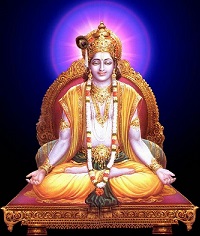
Jnana refers to the overall or complete knowledge. The analytical knowledge is called vijnana; specific knowledge. For example a peepal tree is usually very big and shady. The knowledge regarding the particular family of the tree, the quality and nature of the leaves, the possible age of the tree, the structure and nature of the roots etc; refers to vijnana or analytical knowledge. Jnana in Bagavad Gita stands for the knowledge of the Supreme, the formless and attribute less Divinity. It is discussed in this chapter as to how one can know Paramatma, his qualities and the way to attain Him etc. We can acquire the knowledge of the Supreme by engaging ourselves in the thoughts of Him and His attributes.
Krisna said: Arjuna, hear from Me, depending only on Me and practicing yoga you will know me without any doubt.
I shall reveal you the wisdom entirely, and that by knowing it, nothing shall remain unknown to you.
One among thousands hardily try to realize Me and even among those striving, one or so may really know Me. We know that among many thousands worshippers of God only one or so may strive to know God. Among those striving only one or so will realize God. Most of the people are directed and controlled by sensual desires and satisfaction. A lion majority of the people are disinterested to do any spiritual practice. They are the slaves of their own mind and desires. Even among the worshippers only a very few do worship it in the right direction and also worship by right action. Worships for material benefits are not spiritual. Only such practices being done with the sole intention of attaining God and liberation are spiritual and others are undesirable and meaningless in the true sense of spirituality.
The eightfold factors constituting My Prakriti are ether, air, fire, water, earth, mind, reason and ego. This is the lower nature of Prakriti called ‘Apara Prakriti’. Beyond Apara Prakriti there is the subtle Paraprakriti. The whole universe is within the Paraprakriti that sustains the seeds of life. Those consisting the five fundamental elements and the mind, the intellect and the ego are jointly called‘Asta Prakriti’ (eight fold elements of Prakriti). ParaPrakriti is beyond Apara prakriti and is more subtle. It sustains the whole Apara Prakriti. Para Prakriti is the holder and sustainer of life. The existence of Prakriti has been classified into two as above. Since ParaPrakriti is more subtle the fundamental elements do not exist in it.
All beings are evolved from Para and Apara Prakriti and I am instrumental for the entire creation and in Me all disappear at the end. The world we see around is evolved from Para and Apara Prakriti. It is called ‘Prapancha’ which is a combination of five fundamental elements of Prakriti. The world of light of the Supreme lies beyond Para and Apara. Since the Supreme light (God) is more subtle than Para and Apara both exist within Him. Therefore God is Omnipresent.
Arjuna, there is nothing beyond me. All exist in me like the beads tied by knots on a thread. This shows that nothing is beyond the Supreme. All living and non-living beings are within Him as the beads tied on a thread to form a chain. As God is infinite, everything is within Him and is organized within Him. Only a very few know this.
I am the sapidity in water, light of Moon and Sun and the sacred Pranav (OM) in all Vedas and sound in ether. I am manliness in man. The spirit of everything is the Supreme as He is the originator and sustainer of everything. We need not be proud, over our existence, or self-esteem.
Arjuna, I am the odor of the earth and brightness of fire and the life of the living and the penance of the austerities in men. I am the seed of all beings, the intellect of the wise and the glory of the glorious. There is nothing great beyond the greatness of God. Therefore God is the Supreme and the ultimate cause of everything.
Arjuna, I am the might among the mighty without lust and desires, I am the sexual urge which is not against dharma (right obligation) and virtue. It means that when might and sex urge are not against virtue and moral obligation they are not wrong. There is morally obliged lust and immoral lust urge. Using power for the good of others, is hence right.
Those generated from Sattva, Rajo and Tama gunas; the operative principles of Prakriti, have their origin in Me. But really they do not exist in Me and I am not in them. Everything born out of Sattva, Rajo and tamoguna is originated from the Supreme. The forces of Prakriti; Sattva, Rajo and Tamogunas are blind forces. The Supreme consciousness does not exist in them and these forces do not exist in Him. God is beyond the influence of Prakriti. He does not exist in the blind forces of Prakriti. The purest cannot exist in impurities, formed by operative principles.
The created world and the beings are deluded by the operative principles of Prakriti; Sattva, Rajo and Tamogunas. As these forces influence all beings, the world does not recognize Me, the imperishable. Creation takes place according to the will of Pursa, the Supreme Consciousness and the owner of all powers of prakriti. Prakriti at the will of Pursa creates everything. The soul of individual is veiled by these forces making it difficult to think and know the Supreme. The forces of Prakriti attract the individuals to worldly pleasures.
It is extremely difficult to win over my wonderful Prakriti (Maya). But it is possible only by those constantly worshipping on Me. The veil of Maya is formed by the combined effect of the forces of Prakriti Sattva, Rajo and Tamogunas.Every guna is identifiable with definite charecteristics. The combined name of these three forces is Prakriti. Every being is under the influence of Prakriti. It is very difficult come out from the clutches of Her (Prakriti). It is like the legendary character Sita, went after the deer being deluded by Maya of Prakriti. Liberation is the freedom from influence of Maya. It is possible only by meditating upon Pursa the Supreme consciousness.
Those fools deluded by the influence of Prakriti taking the form of Asura (wicked) and doing cruelties, do not recognize and worship Me. The wicked never think about or worship God. They are low beings in human community. They remain under the strong bond of Maya (Prakriti) and always stand for the enjoyment of their desires. They may try to take into their custody; the wealth of others even by unfair means.
Arjuna, four types of persons of noble creed worship me; those for worldly pleasures, the afflicted (suffering), persons with curiosity and the wise. Worshipping of God itself is different from person to person. Some worship God for wealth, some due to mental and physical tortures, some simply out of curiosity and the wise to know Him. Most of the worshippers are motivated by material gains. Those who worship the Supreme, only for knowing his greatness are superior.
Out of the four types, the best is the man of wisdom, who worships Me fixing his mind on Me with devotion. For the wise I am very loving and so he is to Me. A Jnani (wise) performs his worship to attain the Supreme and for his liberation. He knows the ultimate truth. One gets eternal peace and tranquility only when he is freed from this slavery of Prakriti. The wise worships God knowing this. He loves God and God too loves him. A dear friend advised his son ‘You shall not give others a chance to follow you’. His son was arrogant and ignorant. It is really an interesting piece of advice. Worshipping of God for money and fame is not spiritual.
Though four type of worshippers are virtuous. The wise worshipping Me always fixing his mind on Me is really great. The aim of the wise is to attain Me alone. The wise knows that there is nothing superior to, than realizing the Supreme. The wise has stable and determinate thoughts and goal while other devotees stand for their immediate material benefits and enjoyments. Yet those worshipping God are nobler than those not worshipping Him. A true devotee surrenders his ego to God and hence not egoistic and arrogant. Others easily fall victims of arrogance and the like negativities. A wise man continuously strives for attaining the Supreme while others try to satisfy their silly desires.
It is only after a number of births the wise and the enlightened soul knows Me as Vasudeva (God) and strives hard to attain Me. He knows that I am everything. Such devotees are very rare. Many births are required for one to know even the existence of God. A very long years of right action is needed to purify one’s mind and make it flawless to realize God. True devotees are very rare as most of them are deluded by mundane pleasures. Those who worship God to attain Him are great.
People worship other deities (Gods) according to their desires, nature and intellectual developments or wisdom. Worshippers influenced by desires select their deities. It may be the symbols of divine imaginary figures like Krisna, Ganapathy, Siva, Subrahmanya, Parvathy etc. Various divine forms are worshiped by the devotees to satisfy their desires. The character of the devotee can be understood by the deity being selected for his worship. Some worship Ganapathy (Vigneswara) to get rid of obstacles in their life especially material. Some others worship Kali, Durga etc. to gain mental power. Worships being done to realize the Supreme consciousness is desirable and superior to others.
Whoever devotees worship Me in whatever celestial forms, with utmost reverence, I reinforce their faith. The divine celestial forms are desirable for being worshipped and not the human figures or forms. The divine and imaginary forms are bright, perfect and everlasting. Human beings are mortal, decaying and imperfect. Worshipping human body or human forms are therefore anti-spiritual and anti-God and is done by the foolish and the undeveloped. Everybody is free to select his symbol of worship, according to his nature and wisdom.
He who worships the deity according to his desire, faith and choice shall obtain the desired enjoyment. He who worships surrendering his mind to his deity with faith shall attain the pleasures that he desired. Any result or fruit of worship calls for the total surrender to the deity.
The silly people with low understanding gain the fruits of their worship, which are perishable. Those who worship different Gods attain such Gods. But those worship Me alone attains Me. Most of the different Gods are the embodiment of power and not consciousness. Such worships will not help for the real knowledge of God, but cause to bind the soul to material pleasures. There are some cunning people worshipping several deities or gods without surrendering to any particular deity or Gods. They do not get any benefits. Those worshipping Paramapurusa with utmost surrender of the self attains Him, the imperishable. They find their ultimate refuge in the Divine and merge with Him and enjoy eternal peace and bliss.
The ignorant does not know that I am imperishable and the ultimate truth. He does not know that I am the Supreme spirit i.e. beyond the reach of the mind and senses; and does not know that I do not assume any fixed human form in My births. The God is un-manifest and imperishable. He is the light of consciousness ever existing without definite shape or form. The Paramatma is immortal and He has no births and deaths and therefore he is formless and not having a definite form. However the wise knows Him accordingly and are able to attain Him. A great Sadguru or God shall have different human forms in different births. But these human forms are not the real form of God or Guru. The inner self is more important.
Under the veil of My maya I am not revealed to all. The ignorant will never recognize me. I am the unborn, the imperishable and the Supreme entity. God is not revealed to all. To realize God one should get out of the veil of maya (Prakriti). The vision of the Supreme takes place only in a purified mind. Where the forces of principles of Prakriti are dominant in one’s mind he cannot have the vision of the Supreme. One cannot know God by arguments or by discussions. Arguments are the methods adopted by the egoistic and the arrogant. The presence of the Supreme is felt only in a pure mind. The foolish never realizes God. One has to surrender his ego which is a stumbling block to know the Supreme and that if he performs right actions he can attain Him. Only very few know Him really. One must refine his mind again and again to make it pure, clear and transparent so that the reflection of the Supreme light would appear in his mind.
Arjuna, I know the past, present and future of all beings; but they do not know Me. Paramatma knows the beginning, the present and the future of all beings but this Supreme truth is not known by anybody except by those striving to realize Him, doing right action and surrendering their ego to the Divine. Persons with pure and peaceful minds only can know Him. To those minds agitated like a troubled sea cannot get the true knowledge of the Divine.
Owing to the delusion of the pairs of opposite i.e. dichotomic feelings of pain and pleasure etc. and out of desires and hatred, all living beings easily fall victim of infatuation and passion of love to acquire desired objects. Desires (Icha) refers to the mental status of one towards the sense objects. The world around strongly attracts the individuals towards sensual enjoyments. One loses even his discriminatory power as to what is right and what is wrong. His intellect does not become stable. He tries his best to conquer the world of sensual enjoyments and pleasures. His mind is continuously disturbed by strong desires attracting him to the mundane pleasures and there by getting himself bound by the ill effects of desires.
The virtuous men doing right action again and again, get relieved form the dichotomic pressures (pair of opposites) such as pleasure and pain, cold and heat, good and evil etc. Then they worship Me with stable mind and attain the ultimate goal of liberation from all bondages. One who worships God by doing right action gradually gets relief from the pairs of opposites. The dichotomic factors are positive and negative. One who wins over the dichotomic state of affairs attains oneness with the God.
Taking refuge in Me those who does right actions to free themselves from the birth and death, knows well Brahma and the spiritual truth. Some do sacrifices to know the ultimate truth and realize the creator (Adhidaiva); Adibhutha, the totality of embodied souls or jivas, also Adhyatma. Even at the time of death they get the memory of Me, the Supreme. Those who do right action for attaining moksha (liberation) and strive hard to deliver them from the worldly miseries forever are not attracted by worldly pleasures. Their aim is eternal peace only and they do their actions constantly, punctually and systematically. Power worshippers being motivated by physical desires remain active in satisfying their desires. In their case, the natural course of birth and death continues. Their minds are filled with craving for sensual enjoyments and are impure, unsatisfied and disturbed. We know that at the time of death of a person, people collectively do prayer for the eternal peace of the person nearing death. This remains a good ritual everywhere but the bondages of desire in one do not subside even by death. The irony is that we, the peaceless pray for the eternal peace of the departing soul and that we do not do anything right for our peace.