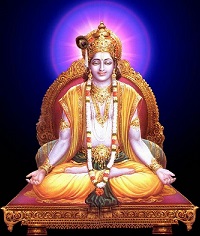
The term Rajavidya or Rajayoga refers to the noble yoga or the great yoga method. Guhya refers to the secret of yoga. Yogavidya is great and secret. It is imparted by great masters or Gurus to their disciples directly and secretly. There cannot be any agent to a great Guru. All are not eligible to practice yoga vidya. The eligibility is to be attained by a certain level of purification of one’s mind. It is the minimum qualification required for imparting Yoga vidya to an aspirant. Yoga is vidya (positive) and if it is not practiced properly it would turn to be Avidya (negative). A word may have a positive and negative meanings and impacts. For example the word Siva and its concept; Siva means pure consciousness (Supreme God or Paramatma). If one worships Siva thinking that He is consciousness it is spiritual. But on the other hand if one worships thinking that Siva is power it is Avidya. Power worship will not help one to attain the Supreme. Therefore worshipping God as power is Avidya. ‘Sa vidya ya Vimuktaye’; it is Vidya that liberates one from all bondages, while Avidya binds one again and again. Here is the clear concept of God in Bagavad Gita as regard to spirituality. Therefore those worshipping God as power can’t attain Him. A spiritual master would impart Yogavidya to his disciple secretly imbibing the right ideation of the concept of God. Yogasana is not yoga. It is Hatayoga; it is physical postures for making one’s body healthy and suitable to practice yoga. Yogavidya is to be imparted secretly to an aspirant and not to a group. Group yoga is suitable for physical exercises only.
Arjuna, I shall impart you, the jealousless one, the most secret knowledge of Nirguna Brahma, so that you shall be free from worldly worries. It is the answer to the question of what is the purpose of yoga. The ultimate aim of the practice of yoga is freedom from miseries. By the practice of yoga one can purify his mind and get liberated from all worries and pains. Nirguna Brahma is a state of pure consciousness.
The practice of yoga leading to the knowledge of Brahma (Nirguna and Saguna) is much superior, secret, most holy, excellent and directly enjoyable, easy to practice and imperishable. The practice of yoga gives one immense pleasure and enthusiasm. It is a divine process to attain the Supreme. It is the practice of Dharma and is the ultimate moral obligation of everybody. Everyone shall one day practice it. It is not simply long inhaling and exhaling of air; into and out of one’s body. One should simultaneously and progressively develop the true ideation of conscious love and affection of Brahma within. Paranyama followed by right ideation may help yoga. Right ideation (Bhava) transforms one’s mind positively.
Arjuna, a man without faith in Dharma and faith in Me failing to attain me goes on revolving in the path of birth and death and of worldly miseries. ‘Asradhadana’ refers to the one without faith. One who does not perform his moral obligation properly shall remain worried throughout his life and the life thereafter.
I, the un-manifest Purusa, exist pervading everywhere and in everything of this universe. Every being is in Me. ‘Mayathatamitham’ refers to the allpervading Brahma. Everything is within God. As God is infinite nothing exists outside Him.
All beings are created by Me but they are not in Me. You may know the divine powers in Me. God has created all beings that did not exist before. The created things are sustained by God. But God is separate from the created beings. The forces of prakriti exist in created things. But God does not exist in the forces of prakriti, existing in created things. He is independent.
As the extensive air exists in the sky, all that came into being from Me exists in Me i.e. I exist all-pervading the universe.
Arjuna, at the time of final dissolution (destruction) all being merge into My Prakriti (ParaPrakriti) and that in the beginning of creation I send them back again. ‘Prakritimyantimamikam’ refers to that all beings, at the time of pralayam (destruction), leaving their physical forms enter into my paraPrakriti which is unmanifest and it is also called the Primodial prakriti (MoolaPrakriti). After Prayala, and at the time of Prabhava My Paraprakriti with the will of Me sends forth all beings. In destruction the physical forms only get changed and destroyed and that the inner self of the individuals will exist in the ParaPrakriti.
According to the nature of beings they are recreated using the power of Prakriti. In the beginning, there is re-creation of those merged in the ParaPrakriti; they all get activated with their characters and come forth manifesting themselves.
I am not bound and attached by any action as there is no bondage of karma in Me. I am totally free, nothing can be an obstacle to My freedom. The God is not tainted by any action. He is free from the forces of Prakriti.
Arjuna, all living and non-living things are created by Prakriti while I am presiding over the process of creation. It is due to this, the wheel of life (samsara) goes on moving. All the creations are the outcome of the communion of Pursa and Prakriti. Prakriti receiving the seed from Pursa does the function of creation. Everything has a subtle and crude form on the basis of the forces of Prakriti acting in them.
Fools, not knowing My real, subtle and infinite form of the Supreme nature, ascribe Me the human form. I am the Lord of all beings, the unwise cannot know Me at all. Those worshipping God in human forms are unwise and foolish. God may incarnate Himself as a great Guru assuming human body. The human body is not the real form of God. He is the infinite light and the infinite consciousness. Only when one’s mind becomes pure he can realize God. Impurities in one keep him away from the Supreme light. It might be the one great Guru taking births in different periods, in different places with different forms and names.
By wrong actions, wrong thoughts and wrong knowledge those bewildered persons depend upon demoniac (devilish) nature. Man does wrong actions under the delusion of Prakriti. The forces of Prakriti existing in one make him even a devil where Sattva guna of Prakriti in him is inactive. Other Gods represent forms or images to satisfy the physical and psychological needs of the devotees. One becomes Ausra or Deva based on the interactions and predominance of forces of Prakriti (Sattva, Raja, tama)acting in him.
Great men worship My Divine nature constantly knowing that I am the Supreme Lord of all beings and the imperishable consciousness. Divine forms refer to the shining images spreading light around. Divine forms are, therefore, represent the Supreme. They are power oriented and also conscious oriented. Those conscious oriented, only are spiritual. There are many worshipping the images of God in His power forms to amass wealth, power and fame. They do not actually worship the Supreme consciousness. They are in the wrong direction.
My devotees worship Me with resolved mind, surrendering unto Me, chanting My names and glories striving to realize Me. A true devotee is stable minded and humble, always surrendering himself to the Supreme with purity of mind and doing right actions. His life is exemplary.
Those who follow the path of knowledge worship Me offering their knowledge in my formless state considering Me as one Absolute. There are many who worship Me differently in many celestial forms. Those who worship God formlessly are following the way of knowledge. It is not wrong to worship God in the imaginary but Sattvika form (positive form). A devotee can get his mind fixed in the beautiful forms appeared shining and spreading divine light around. It is desirable to worship the divine forms of Krisna, Siva, Ganapathy etc. One should imbibe the Divine ideation of the Supreme consciousness and not the Supreme power. Where the worship tends towards power it may become negative and would not help for the purification of one’s mind. Power worship is in the wrong direction shall not help for the freedom of the soul and hence is anti spiritual.
My devotees must know that I am the Vedic ritual, the sacrifices and the offerings made to the death (Swada). I am the medicine, the mantra (sacred words), the sacred fire and the offerings of oblations into the fire. I am also the act of sacrifice into the fire. At a stage a yogi feels that everything is the Supreme. Even otherwise one can think so. It is the feeling of ‘Ekam Brahma’ (feeling of oneness). While performing sacrifices or yajna one should feel that everything is His manifestation.
I am the father, mother and grandfather of the universe. I am the sustainer of the universe, the divine syllable ‘Omkara’ and the Vedas; Rik, Yajur and Sama. I am worth knowing and the purifier of all. The origin of the universe is from the infinite and the beginningless Supreme entity (the Supreme consciousness). The Paramatma is the protector of all beings. He is the divine Omkara that purifies the minds of the person chanting it.
I am the ultimate goal of everybody, the ruler, the witnessing entity, the Supreme abode, friend, resting place, store house, beginning and the end and the imperishable seed of every being. It states that everything is originated from God, everything is sustained by God and everything merges with Him ultimately.
Arjuna, I am the one giving you heat and light in the form of Sun, hold back water and send forth as rain. I am the immortality as well as the death. Pursa is the owner of the qualities of Prakriti; Sattva, Raja and Tama.
The wise men who know the three Vedas; may conduct sacrifices for washing off their sins. They drink the sap of the Soma plant, worship Me attain the heavens and enjoy celestial pleasures in the world of Indra. Though some people know the Vedas they wish to enjoy pleasures only. Those who worship God surrendering to Him without any desire for enjoyments are the true devotees. Those who worship God for material pleasures shall remain in the world of Indra and enjoy sense objects. Indra represents the sensory organs. Therefore Indrabhoga is sensual enjoyment.
Those wise men who desire to have the enjoyment for their virtuous action; reaching the extensive heaven, return back to the earth on exhausting the stock of their merits. Those craving for enjoyment fall victims of birth and deaths. Though one knows Vedas he may have the desire for sensual enjoyments. He may perform rituals with intense desire of worldly enjoyments; and may repeatedly take birth becoming the easy victim of the fruits of his action.
Those who worship me without the desire of worldly enjoyments and constantly engaged in the thoughts of Me; I guaranty that their welfare would be taken care of. Yogakshema, refers to whatever a devotee needs. It may be material or spiritual. Once a yogi surrenders everything to God and performs his duties and worships God without any desires; the God shall look after him providing him with all the necessary needs. It is perhaps, the greatness of Bagavad Gita because no such assurance is given in any other philosophies.
Ajuna, those worshipping other Gods with faith but with some motives are also worshipping Me, in a mistaken way. Most of the forms of other Gods are images of power and that such symbol worships are conducted for certain specified material purposes. They may get power in the form of mental or physical pleasures. Some may get certain extra ordinary psychic powers and they may befool the people as though they have realized the Supreme. Power worship is non-spiritual and is often harmful.
I am alone is the enjoyer of all sacrifices (yajna) and the Lord. Those who worship other Gods (images) without really knowing Me, fall into miseries again. Some may worship other Gods like Agni, Varuna, Indra, Kali, Durga, Lakshimi etc. with definite motives. However those who worship the Supreme consciousness alone reach Him.
Those who worship Gods (other gods) attain them and those who worship their forefathers (manes) reach them and those worships spirits attains them. But those devotees worshipping Me alone reach Me. Man worships Gods, spirits, manes etc. Those worshipping different forms or symbols attain only the qualities attributed to or ascribed to such symbols or images. There are some performing sacrifices for the dead and gone; parents or forefathers. After death such worshippers may reach the world of the dead. There are negative images or symbols like Bairava, Yekshi, Satan etc. By worshipping images one attains the psychic status or meanings ascribed to such images. The worship of Paramatma is the most desirable and should be performed and it is only spiritual.
A devotee who offers to Me with love a leaf, a fruit, a flower or water; I accept them as being the worship of a purified and divine soul. God accepts any offerings with love by the devotees who are purified. A leaf represents peace and calmness of a mind; fruits, the fruits of action and milk the protective force, ghee is the image of love and butter the image of life. By offering the above an individual satisfies the internal images of Gods. Every offering has as ideational realm.
Therefore, Arjuna, you shall perform all actions thinking that the food you take, the materials you offer in sacrifices and the wealth you give as alms and the 161 penance you undertake are due to My grace and should be performed surrendering unto Me.
He who worships Me established in the yoga of renunciation, fixing his mind on Me, without considering the good and evil results, shall be relieved from all bondages and shall attain Me. The pain of every soul is the bondage of action by which its freedom is blocked. Therefore one should take the true ideation of God before an action is performed, to get rid of the bondages of action.
I am present in all beings equally. I do not hate anyone or anyone is dearer to Me. However, those who devotedly worship Me exist in Me and that I am revealed to them. Paramatma is present in everything equally, though he neither hates nor loves anybody. Neverthless, those who worship Him with devotion are dear to Him. It is stated that there exists a continuous interaction between the devotees and God.
Even if the vilest sinner worships Me with faith and exclusive devotion, he should be considered as a saint and that he has come to the right path. Everybody who is a slave of Prakriti commits sins continuously. Sins refer to the actions not desirable to the doer and the society. There may be nobody who has not committed any sins, having taken birth on earth. A sinner is also eligible for liberation provided he refines his mind and devotedly worships the Supreme consciousness, without any desire. One who has not refined his mind goes on committing sins one after another.
Arjuna, My devotee who is established in Dharma becomes virtuous and speedily attains the lasting peace. My devotees shall never fall. Dharma refers to right action. He who does right action with faith in God shall not meet with perils.
Women, business men, Surda (laboring work men) or those took birth in the sinners family can also attain the Supreme provided they find shelter only in Me and worship Me accordingly. 163 There is a common place concept that women, business men and those who perform physical work only (Surda) may find it difficult for their spiritual progress. They are mainly inclined to worldly pleasures. It is difficult for them to come to the right path. They can also get liberation provided they do their right duties worshipping God with due devotion and surrender.
The holy Brahmins and royal sages who worship Me devotedly would reach Me. Therefore, you should worship Me constantly, for having obtained the human life.
You must fix your mind on Me, devoted to Me, worship Me with reverence and humbleness of mind and totally depending on Me. You shall attain Me. The above stanza gives a clear idea as to how one should worship God. One must have a stable mind, devotion and reverence to God, a humble mind and total surrender unto God.