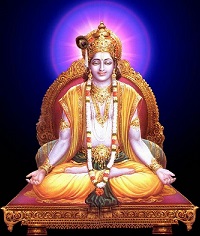
Parmapurusa (Supreme consciousness) is Purushotama. The process of attaining Purushotama is Purushotama yoga. It is the most desirable and greatest of all yoga practices. The aim of a true spiritual aspirant is to attain Paramapurusa who is beyond the purview of the forces of Prakriti. The Purusa is Omnipresent, Omnipotent and Omniscient. It is a process to attain or become one with the Supreme Purusa. Akshara Brahma is beyond the influence of the three forces (gunatita). Purushotama is totally free from the forces of Sattva, Raja and Tamogunas. The aim of everybody must be to reach Him at the state of blissfulness. When one is totally free from the grip of gunas or Prakriti, he attains the all loving Purushotama.
Sri Krisna said: The wise men refer to an imperishable pipal tree whose roots
are directed upwards to the heaven and its stem and branches grow spreading
downwards. Its stem represents Saguna Brahma and the leaves are said to be the
Vedas.
The pipal tree whose roots is directed upwards and branches grown
downwards, is an internal vision of great yogis. The roots of the tree are directed
towards the Nirguna Brahma, the infinite, and the whole vision is an archetypal
form of the entire created universe. It is said that the leaves of the tree represent
the great Vedas.
Branches of a pipal tree may extend upwards and downwards. The operative principles of Prakriti; Sattva guna, Rajo guna and Tamo guna help the tree to grow. It is also said that the tender leaves of the tree represent the sensory organ of sound.
It is very difficult to know the real form of the infinite pipal tree; It’s beginning and end are not known. One must cut off the pipal tree from his mind as it represents the physical world. The tree is to be cut off by the axe of detachment. Only by cutting off the tree, one can escape from the world of miseries. The symbol of the pipal tree represents the Apara Prakriti.
A man, of true wisdom who is free from egoism, delusion and attachment and is trying to attain the Supreme, and who has freed himself from the dichotomic feelings of pains and pleasures; reaches My immortal state.
The Supreme effulgent state of God cannot be further brightened by the sun or the moon as it is the origin and the flow of infinite light. Those reaching that sate would never return back. It is the ultimate abode of everyone.
The jivatma (unit consciousness) is a particle of the Supreme being which is attracted by the mind and is controlled by the sensory organs by the interactions of the operative principles of Prakriti. The mind encircles the soul which is beyond the senses and the principles of Prakriti. The unit self is covered by the delusion of mind keeping it under the control and bondage. Therefore the soul suffers or enjoys the fruits or the results of actions of the mind. Mind being the combination of the principles of Prakriti is blind, without the soul. Therefore even the feeling of ‘I’ is caused by the presence of the unit soul. Moksha (liberation) refers to the total freedom of the soul from the slavery of the mind.
The jivatma while leaving the body along with mind and the principles of senses moves in search of another body. As the wind moves taking the scents of flowers, the reactions in their potential forms of actions are transferred from one body and enters into another. Karmapasas (bondage of actions) are transferred from one birth to another until they are removed by purifying one’s mind by the practice of yoga with true ideation of the Supreme.
The jivatma (soul) enjoys the sense objects with the help of mind and senses as hearing, sight, touch, taste and smell. The soul is under the bondages of Prakriti; Sattva, Raja and Tama gunas. It is like a caged bird enjoying the food offered to it. But the bird always wishes to get out of the confinement; such is the condition of the soul being enslaved by the mind.
The unwise and the ignorant do not see the soul as different from the body even by sensual enjoyment or at the time of the soul leaving the body. The irrational and ignorant people do not and cannot know the different entity of the soul in the body. They do not have any sense of the operative principles of Prakriti either.
Only the wise striving for attaining the real knowledge realizes the existence of the soul different from their mind and body, beyond the scope of Prakriti. The soul is as pure as the Divine consciousness. It cannot be polluted by the forces of Prakriti though the unit self is under the control of the mind, being influenced by the forces of Prakriti; Sattva, Raja and Tama.
Arjuna, the light of the Sun and the Moon illuminating the entire world is that of Mine. The glow of the fire is also Mine. The Supreme self is also called Ananthasuryanarayana (the infinite sun of light).
I, do permeate into the earth and exist as the vital force of living beings and as the moon nourishing all the plants.
I am instrumental for digesting the food in the body of living beings in the form of fire (Jataragni) uniting with the ingoing (Prana) and the outgoing breaths (Apana).
I am seated in the heart of all beings, act as the controller of memories, the source of knowledge and cause of ignorance and oblivion.
There are two names attributed to the Supreme consciousness; the Akshara Purusa, the imperishable and Kshara Purusa, the perishable. The Purusa existing in the body of all beings is Kshara Purusa and the Purusa existing in the communion of body and senses is Akshara (soul). The Purusa existing in non-living beings where there is no communion of the body and senses and that under goes changes is Kshara Purusa. The soul in a body characterized by the senses and mind, is Akshara and is imperishable and not changing.
There is another name of Purusa different from Kshara and Akshara, i.e. Utamapurusa that sustains all the world of existence and it is the Supreme soul or spirit.
I am the Supreme self, different from My particle (soul) in its nature of infinity and is beyond the imperishable particle of the unit self in living bodies. I am therefore called the Purushotama the Supreme person.
Therefore Arjuna, the wise men realizing Me as the Supreme person and the all-knowing constantly worship Me as the all-pervading entity.
Arjuna, you being sinless I have imparted to you the most secret and esoteric knowledge of yoga. Knowing the spirit of this, one becomes wise and consequently his goal is accomplished.