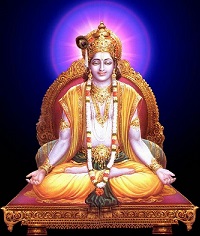
The war started. On the tenth day of the terrible war Bhishma, the captain general of the Kaurava army falls down by the arrow of Arjuna of the Pandava army. Sanjaya comes back and tells Dhrutarastra that Bhishma had fallen down. Hearing this Dhrutarastra falls unconscious for a while. When he woke up he asked Sanjaya to describe him in detail, from the beginning of the war, what had happened in the war field. Sanjaya describes with the help of his divine vision, the things that happened in the war field right from the beginning of the war. It is the situational background of Bagavad Gita, being revealed by Sri Krisna to Arjuna, as narrated by the great seer Vedavyasa.
The two armies were got ready for the war. Kauravas and Pandavas were cousin brothers. There were many relativities, friends and Gurus on both sides arrayed for the war. Bhishma and Drona were revered by both the Pandavas and the Kauravas; Bhishma being the great grand uncle of both the parties. He loved the Pandavas and Kauravas and was an undefeatable warrior. Seeing the great grand uncle Bhishma, Drona, friends and relatives; Arjuna underwent severe pressure and grief and that his mind was filled with fear and perplexity.
This chapter contains the mixed reactions of Arjuna, the great Pandava warrior on the commencement of the war. It is serious to note that a powerful warrior like Arjuna remains spellbound and frightened in the war field. In a war, all good relationships with the opponents ends.Any war conducted for physical benefits would bring pain and menace, though there are justifications on either side. A war may witness the shouting and cries of the wounded soldiers, and animals used in the war. Arjuna becomes nervous and reluctant to wage the war and puts forward a number of justifications not to fight the war. It is not proper to retreat from the war that has already become certain. Arjuna fears to fight against Bhishma and Drona. There is a saying that a person who chants the ten names of Arjuna would get relief from the complex of fear. But Arjuna fears. It is natural that if a powerful person is compelled to fight against a more powerful, there would generate fear in him. Arjuna debates vehemently with Sri Krisna, by logical justifications that he is not ready to fight. If so, Arjuna would have taken the decision well before coming into the war field.
Dhrutarastra asked Sanjaya: What did they do who gathered in the war field of Kuruksherta, ready to fight in the war between my children and the children of Pandu? Dharmaksetra refers to the place where the fight is going on between the good and evil forces. The poetic connotation is that a conflict is continuously going on in the minds of the individuals and in the society between the good and the evil forces. sanjay uvāca
Sanjaya replied: Seeing the arrayed army of the Pandavas, the king Duryodhana, approaching Acharya Drona, said the following words
O Respected Master, please see the powerful army of the sons of Pandu arrayed for the fight under your able disciple Dhrstadyumna, the son of Drupada.
There are many mighty warriors in their army equal to Bhima and Arjuna such as Sathyki and Virata and the warrior chief Drupada, Dhrstaketu, Cekitana and the great warrior king of Kashi, Purujith, Kuntibhoja, Saibya, Yudhamannu, Uttamanja, Abhimanyu (the son of Subhadra) and five sons of Draupadi, all of them are eminent warriors.
In our army there are great warriors like you (Acharya Drona), Bhisma, Karna, Kripa, Asvathama, Vikarna, Bhurisrava (Son of Somadatta) etc., who are ready to sacrifice their valuable lives for the sake of me.
Our soldiers arrayed under Bhisma are more powerful than those arrayed under Bhima.
Our warriors should be very careful to safe guard Bhisma, our warrior chief, taking their positions from all sides.
The great grand uncle Bhisma, to cheer up Duryodhana and his army and to signal the beginning of the war, blew his conch loudly like the roar of a lion.
Different type of conchs, kettle drums, drums and trumpets made tremendous noise making the atmosphere dreadful.
Then Sri Krisna and Arjuna, seated in the famous chariot drown by white horses blew their conchs
Sri Krisna blew his conch named Pancajanya and Arjuna his conch Devadatta. Bhima blew his powerful conch Paundra.
The king Yudhistira, the son of Kunti, blew his conch named Ananthavijaya. Nakula and Sahadeva blew their conchs Sughosa and Mainpushpaka respectively.
There after the strong fighter the king of Kasi and Sikhandi ( the great warrior), Dhurstadyumma, Virata, Sathyaki,Drupada and the five sons of Draupathy and the powerful fighter Abhimannu(the son of Sudhadra) blew their respective conchs.
The terrible and dreadful sounds produced by the conchs echoed in the sky and the earth as if a strong warning to the sons of Dhrutarastra.
Arjuna, seeing the arrayed armies ready to start fighting, requested Krisna to place his chariot in the middle of the two armies.
He wanted Krisna to place the chariot in such a way between the two armies so that he could well observe the warriors against whom he would have to fight.
I shall have a look on the well-wishers of the crooked Duryodhana, ready to fight against the army of the Pandavas.
Sanjaya said to Dhrutarastra: As required by Arjuna Sri Krisna drove the chariot and placed it in the middle of the two armies in front of Bhisma and Duryodhana so that Arjuna could see both armies well. Sri Krisna then asked Duryodhana to behold the Kauravas assembled for the war.
Arjuna very carefully observed and saw his uncles, grand uncles, Gurus and also the great grand uncle, maternal uncles, brothers and cousins, sons and nephews and grand nephews, friends, fathers in-law and other well-wishers.
Seeing the close relatives arrayed in the battle field, to fight against his army, Arjuna was filled with compassion and told the following words to Krisna, in utter distress. My body becomes unsteady to stand straight, mouth is parching, and shiver runs all over the body and hair stand straight. (The divine bow Gandiva slips from the hand of Arjuna). He tells my body suffers from much heat, insufferable.
Krisna, I see omens which are against me and I do not see anything good in killing my kinsmen in the battle.
Krisna, I do not want victory or the kingdom and pleasures. What is the use of the kingdom and pleasures even life, killing my relatives?
I do not like victory in the battle and any pleasure or kingdom killing the opposite army arrayed in the battle field, leaving everything. They are my close relatives and friends. They include my teachers, friends, uncles, sons and nephews and even the great grand uncles, fathers-in-law and sons.
O slayer of Madhu, even though those who have arrayed to kill me or even I get the power of three worlds, I do not consider it as much valuable as their lives.
Krisna, what is the use of killing Kauravas? I do not wish to kill them though they are ready to kill me. Killing them is a sin.
Therefore, Krisna it is not proper to kill our relatives, Kaurava. We cannot remain happy and peaceful killing the good people.No one can remain peaceful killing good people.
By capturing the kingdom, in the battle, the race will be destroyed. How can we who know well the sin of loss of one’s family and the race, fight the war?
The age long Dharma of the family would face destruction and the virtues will disappear and that the result of the war would be the vices taking hold of the race completely.
As a result of over powering by the vices, the women in the families will become morally corrupt and that it will pave the way for the intermixture of castes.
The intermixture of castes would invariably destroy the race and shall cause for not performing, sradha like rituals offering rice and water to the dead and gone.
The intermixture of castes, would also cause for the cessation of age old traditions and rituals of the family of the relatives.
It is said that if one does not practice the traditional rituals of the family shall remain in the hell for long.
What a pity it is? We have decided to fight and have committed a great sin by it. It is due to the lust for the throne and kingdom even by killing the kinsfolk.
I feel it would be better even if I am killed, unarmed in the battle, by the sons of Dhrutarastra.
Sanjaya said, having stated so, Arjuna, leaving his bow and arrow, with agitated mind, in utter sorrow and fear sat back into the chariot.