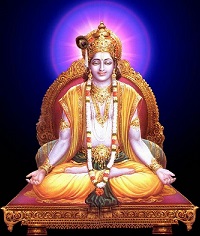
There seldom exists right knowledge or right action alone. Right action and right knowledge are jointly called JnanaKarmayoga. Samnyasa refers to one’s total surrender to God.The way by which one can lead to a peaceful life, surrendering himself to God is discussed in this chapter. What is important is yoga i.e. the union of soul with the God. The ultimate goal of every soul is its communion with the Supreme consciousness.
Normally there is an aversion to the term moksha or liberation, to many. Some one say, “I do work hard for my own benefit and not for moksha.” It is due to the fact that he does not know the meaning of the term moksha. It means complete freedom of the soul from all the bondages and the merger of the self with the Supreme in a blissful state. One has to liberate himself from the state of happiness and miseries. At the state of perfect peacefulness one is totally free from internal and external bondages, miseries or joy. Everybody does his action knowingly or unknowingly to attain the state of complete peace and tranquility. Freedom is not to do anything and everything but to do the right action without being the slave of the mind. Positive actions take one towards God, whereas the negative deeds keep him away from the Supreme Self.
Wrong action binds ones soul to the mundanities and the consequent tortures of the atma. But most of the people do not know the fact. A story comes to the mind. A boy who was very poor and humble, gets a good job, soon after passing his degree and becomes so arrogant, changing his attitude in talk and looks. He used to make complaints of his heavy work but was mainly concerned with his fairly high income. Once a gentleman asked him whether he had any complaints in taking delicious food and that instantly stopped his complaints of the hard work. He does not know that he is torturing his soul without being satisfied with the job he got by God’s grace and the good income. Such a person shall never be happy or peaceful in his life unless he changes his attitude. One must be committed to his duty and perform right actions surrendering his self (ego) to the Supreme. Usually surrendering to the Divine or valuing the words of the Guru is only till one becomes financially independent.
Krisna said: I taught the secret knowledge of the immortal yoga first to ‘Vivasan’ (Sun god). Vivasan imparted this knowledge to his son Manu and Manu to his son Iksvaku. This shows that yoga vidya (the practice of yoga) existed from time immemorial and is immortal. The miseries and pains disturb human mind always. He wants relief from his worries. But man’s prayer is to free from worries and not from happiness. If there is happiness there is pain too. Both are either sides of the same coin. The miseries and happiness here refer to sense related experiences. But ultimate happiness (peace) is not related to senses and is beyond the senses. Freedom forever from sensual pleasures and pains is liberation. It is not attained by death. Therefore committing suicide is not a way to escape from pain and pleasure. Births and deaths would be followed by the potentials of the results caused by ones actions. Mind carries along with the soul the bondages of actions all along from birth to births until the mind is completely purified.
The knowledge of yoga transmitted from generation to generation remained known to the royal sages and lost its greatness, spirit and relevance in the course of time. Any practical knowledge shall lose its significance, if not properly followed, by the passage of time. The same is applicable to yoga vidya too. Novelty refers to improving and modifying of the old according to the needs of the time. Human mind is compared to a copper bangle that requires polishing every day or otherwise it would become impure. It becomes clear that one’s mind will remain pure and shining only by refining it every day.
Arjuna, the very same yoga of the days of yore (ancient) is imparted to you today because you are my devotee and friend. It is of supreme secret. Secret knowledge means that everybody is not eligible to know it. There is a saying that Yogavidya shall not be imparted to all. One has to become qualified to get the knowledge of secret of yoga. Yogavidya has now become a tradable service. It may lead to many miseries as it is imparted against the advices of great seers or Gurus.
Arjuna asked, that Vivsvan’s period of life traces back to antiquity and therefore how can I believe that you really imparted yoga to him? It is said that great Gurus are the representatives of God. They are immortal and will always be present and that they do not attain liberation. They would be present on earth to guide others. They change their body from one to another; change of form only. Birth, death and rebirth are hard cores to the Western philosophies. To know this too, one needs purity of mind and thought. Many want sensual enjoyments even by practicing yoga.
Sri Krisna said: Arjuna, there had been many births to you and Me. I know them all but you do not. It reiterates that the knowledge of Bagavad Gita is based on rebirths though the religions like Islam, Christianity etc. do not believe it. But they mention about the life after death; i.e; about hell and heaven. The philosophies originated in the East, very deeply analyze this concept and it seems more logical and convincing.
Arjuna, though I am unborn and deathless I manifest myself with the help of my yoga maya, the divine Prakriti and maintain my own nature under my control. Sadgurus are the true representatives of the Supreme. They have overcome the phenomenon of births and deaths and are therefore immortal. They take births at their own will. Ordinary human beings get rebirth in accordance with their bondages of karma. They are not free. Birth and death continues to them until they get liberation.
Whenever there is a decline of righteousness and there is upper hand of evil forces, in the society, I Myself reincarnate. The term incarnate refers to the descendance of a great Guru from the heavens above. Where there is severe decline of virtues in the society, overwhelmed by evil forces; to maintain a balance between the two is inevitable. Here is a relevance and significance of a great master or Guru.
For the protection of the virtuous and for destroying the evil doers and for establishing righteousness (dharma) on earth, I reincarnate from age to age. It is always the virtuous who suffer much pain and miseries for they partake the miseries of others. When there is an impending great tragedy to the virtuous, a great Guru or redeemer takes birth to protect the good from the wrong doers. The great Gurus are those able to keep their minds always in the thoughts of the Divine. There is a continuous conflict between the good and the evil in the society and in the individuals.
Arjuna, he who knows well My births and the divine purpose attains Me while leaving his body. There will not be a rebirth to such a devotee. It is very difficult to know a great Guru but possible by one constantly meditating on the Supreme and purifying his mind.
My devotees devoid of passion, fear and anger and engaged in the pursuit of My thoughts, purified by penance and wisdom would essentially merge with Me. Merger of the unit soul with the Paramatma is yoga. Desires, fear and anger are the main enemies of human beings. When one wins over these instinctual desires he gets positive results of his right action. Man of great wisdom attains the Supreme consequently.
Arjuna, howsoever people may worship Me I bestow them with My blessings. The concept of God is not the same to everybody, and that the symbols or deities of worship are also different. Most of the people worship God for their material gains and not for knowing God or for liberation. The worshippers seldom state that they worship the Divine for the purification of their minds and to attain God. The People worshipping God for the satisfaction of their desires may get their objects of pleasure but their souls will be further bound by bondages.
Many do their actions (karma) to please the Gods to attain worldly pleasures. They may get the result of their actions in the form of sensual enjoyments soon. Actions being performed for material benefits do not come under the ambit of spirituality. It may be for the early marriage or to cure diseases, to remove the ill effects of enemies etc. But true worship would be to attain the ultimate peacefulness and the Divine. It is to release the soul from the grip of the mind to merge it with the Paramatma.
The four orders of the society were created by Me, categorizing the people according to their nature on the basis of the influence of the operating principles of Prakriti acting in them; though I do karma I am not bound by action (karma). An individual’s mind is influenced by the operative principles of Prakriti; Sattva, Rajo, Tamogunas. According to the intensity and combination of these forces there is change in the structure and nature of one’s mind. He whose mind is predominantly influenced by Sattvaguna (sentient force) is called Brahmana and those predominant by Rajoguna and next by Sattva guna are called Ksatriyas. Persons predominantly influenced by Tamo guna and secondly by Rajoguna are called Vaisyas. And those influenced predominantly by Tamo guna without considerable influence of other forces are called Sudras. This has no relevance to the categorization based on the community in which one is born. ‘Janmana Jayate Sudra and Karmana Jayate Dvija, is a Vedic statement which means that everybody is Sudra by birth. Dvija refers to a person who by right action has modified his mental structure in such a way where Sattva guna has become predominant. The state of Brahmamahood can be attained by right action even by other categories by the constant ideation of the Divine. This concept of Bagavad Gita has been misconceived and misinterpreted by many stating that the four Varnas (categories) are by birth. Thus Brahmanas are those engaged in the pursuit of priesthood and worshipping in temples. Ksatriyas are those protecting the society from the enemies, Vaisyas doing business and rearing of domestic animals and Sudras doing menial work for the other three categories.
I am not tainted by Karma (action) and have no craving for karma or fruits of karma. Those who know rightly this,too shall not be tainted by action (karma). Though God does actions, He is not affected by Karmapasa (bondage of action).If one is affected by Karmapasa, it cannot be a selfless action (Nishkamakarma). He who thinks that he is only an instrument in the hands of God in performing action would not be affected by the bondage of action.
The ancient seekers of knowledge and liberation had performed their actions knowing the truth of Karma Samnyasa (surrendering the fruits of action to God). Hence you shall also do your actions following their path. It is only by following right action without karmapasa, one can progress towards the goal of liberation.
The question as to what is right action and what is inaction, even the wise men are puzzled. I shall make you clear the matter. Knowing the secret of the truth, you can free yourself from karmapasa (bondage of action). Those actions influencing and affecting the human mind are karma. It may positively or negatively affect the doer.
One must know what is karma, what is akarma and what is vikarma. The influence of karma is really mysterious. One can do the right action only by knowing the direction of the action. A yogi, spiritual aspirant should essentially know it. Karma is right action, akarma is inaction and vikarma is wrong action or prohibited action.
One who sees akarma in karma and karma in akarma is wise and a real yogi. Karma (action) refers to the actions being performed by the body, the mind and the intellect. But ‘Yukta karma’ refers to the duty one must perform. He who sees karma in akarma performs his moral obligation leaving the doer ship of karma in God. A true yogi is he who is able to shun away the bondages of action. Spiritual progress is arrested by the actions bringing bondages to the doer.
He whose actions are devoid of sensual desires and who burns the bondages of his actions in the fire of knowledge, without craving for the fruits of action, is considered a sage by the men of wisdom. Actions being performed without the intention of sensual desires do not cause bondages of action. He who does actions accordingly is really a spiritual aspirant or yogi. The wise, surrender the fruits of action unto God and gets relief from the burden of the bondage. The feeling of doership disappears from him. He thinks that he is only a medium or instrument and that action are performed by the Divine will.
He, who is involved in actions without attachment and without depending on anybody, is wholly satisfied because the bondage of action does not affect him. He feels that he does not do anything. The doer ship is not in Him. It is not in the performance of an action, but in not being affected by bondage of action that matters. The ‘I’ feeling (the doer ship feeling) and the ownership feeling attract bondage of action. When action is performed as a Divine guidance no bondage of action exists in the mind of the doer.
He who performs action subduing his mind and body and surrendering to the Supreme, giving up craving for all enjoyments for sensual objects, thinking that he is merely an instrument for doing right actions will not be affected by the bondages of action. A person having no desire shall not be interested in the fruits of action. Whether the result is good or bad he is not worried or affected. He feels that he has no particular interest in any thing. He feels perfectly satisfied and experiences immense internal peace. There are very few who experience enduring peace within. Surrendering the knowledge and actions to God is Jnana Karma Samnyasayoga.
He who rejoices in unexpected gains, who is devoid of jealousy, who has won the pains of dichotomy, who maintains equanimity in success and failure; does not fall in the veil of the bondages of action. The virtuous may become happy if he gets some benefits unexpectedly. But if someone else is awarded by lottery winning of Rupees one core, he may immediately be very much concerned with the tax deduction at source. Such people attract more and more bondages to their souls even by unexpected gains. Dvanda (duality) refers to the positive and negative aspect of everything such as good and evil, happiness and sorrow, cold and heat etc. One can be a yogi only after winning over such dichotomic influences.
One, who is free from attachment, established in the knowledge of God and does all actions for the welfare of others; bondage of actions shall not affect him. Attachments and desires are the major causes of bondage of action. When one who does his action for the good of the society it becomes a sacrifice and also when he surrenders his doership, to the Supreme. Doing service to the humanity is really a sacrifice. But we see that many of our leaders; political or otherwise are mainly enjoying the benefits of society without any sacrifice. They are really parasites. When reward is paid for any service it becomes, no more, a sacrifice. Any wealth that we amass by improper ways contains the seeds of poison in it.
The devout spiritual aspirants, may feel the presence of the Supreme everywhere especially in rituals like homa (sacrifice). One who offers oblations into fire, taking the ideation that the materials used in the sacrifice; the spoons, utensils, oil or gee etc. as Brahma or part of God itself; gets relief from all bondages of action and it helps him to attain the Supreme. Where a person performs his actions thinking that everything as Brahma, invariably attains a state of ultimate blissfulness. When a person does an act of yajna with the true ideation of the Supreme, in the course of time, enters into the realm of Bhrama or the Divine.
Some do sacrifices (yajna) for satisfiying their favorite deities or Gods. Yet others thinking that everything is Bhrama offer materials by pouring into the sacred fire. They even sacrifice their minds in the sacrificial fire. They become eligible for liberation. Yajna are usually performed for pleasing certain deities, the conceptual Gods within. No sacrifice is spiritual if it is motivated by material gains or to satisfy one’s desires. The sacrifices may be to please the deities like Ganapathy, Durgga etc. But the purposes for most of these sacrifices are material gains. The concept of welfare of others is almost absent. Where some do rituals or sacrifices with true ideation of the Supreme, for the welfare of all, it shall not bring any bondage. When one does action for his own material benefits, it essentially binds the soul with karmapasa. Those are really spiritual aspirants who do their actions for the welfare of society and for the purification of their minds.
Some sacrifice their senses in the fire of self-restraint. Sound like the sense objects are sacrificed in the fire of senses. Sacrifices are really acts of refining one’s mind. Yajna or homa (sacrifice) is to remove the ill effects of sensual instincts and desires. Sense sacrifice is a psychological practice or technique of action to win over sense instincts or desires. The desire to see is generated by the sense of eye. So are the desires to hear, taste and to touch and smell. Performing homa (sacrifice) with deep ideation of the Divine would essentially help one to do away with mental distress caused by negative and subtle forces.
Some do the act of sacrifice of Prana (the vital airs) and senses into the divine fire of yoga, by controlling their minds; in the light of practical wisdom. Prana refers to the vital airs. The secret of paranayama is to control the senses and thoughts by long and deep inhaling of air into one and slowly exhaling it out. In the view of the Masters of yoga pranayama helps to normalize the blood circulation, so also the thoughts. It needs a proper Guru otherwise it may lead to more complications. The experience of a real yogi is that ignorance can be burned in the fire of knowledge.
Some people do sacrifice with the prescribed materials, some others do thapa yajna and some do yogic exercises. Yajna refers to a karma (action) being done with utmost carefulness and seriousness. Some others do yajna of scientific knowledge or wisdom as revealed by secret scriptures. Sacrifices are performed with definite purposes. Yajna performed for a common cause becomes a real sacrifice. Sacrifices also mean giving up one’s enjoyment for others, i.e. doing action without selfish motive. In a homa negative forces of subtle vibrations are attracted and put into the sacrificial fire through the medium of materials like ghee, beated rice, camphor, oil, mustard seeds, kernel of coconut and so on. Though it looks unreasonable and illogical; to a common mind, from experience, it has been found that such practices are very useful. It is based on the deep and subtle psychological science. Everybody is not expected to know the secret of sacrifice or to perform sacrifices.
Spiritual aspirants have found that by controlling the function of lungs with the help of long inhalations and slow exhalations of air (pranayama) they can control their senses and thoughts. By controlled food habits and regular yogic exercises like pranayama one can control his vital forces. The air we take in is called prana and the air we exhale is called Apana. The time gap between inhaling and exhaling is called Ayama.
The leftover materials used in the sacrifice to the deities are considered as nectar by the devotees. Therefore it is said that the left over materials are the blessings of the God, which are not bound by the bondages of action. If a person takes food, only after submitting it to the deity, represented by the Divine regularly, in the long run his mind will become pure and unaffected by the bondage of action and attain liberation from worldly miseries. The inner feelings must be of total surrender. We have experiences that at famous temples there are long queues of devotees to get the leftover food items sacrificed to the deities. There is a science behind it, a psychological science of getting inner peace.
There are different types of sacrifices discussed in Vedas (Holy Scriptures). All sacrifices are originated form karma (action). When one realizes this truth he will be absolved form the bondages of action. Every sacrifice has an ideational realm. Right ritual is a march towards the Divine.
Arjuna, Sacrifice through knowledge is superior to the sacrifices being performed with material things. However all sacrifices ultimately culminate into knowledge. Sacrifices are performed in the sacred fire chanting divine words (mantras) and syllables, offering into the fire, materials like ghee, beated rice, pieces of coconut kernel, and nine important cereals etc. The ideational meaning of the mantras is related to knowledge.
You shall approach the great seers and scholars with utmost humbleness, respecting them and rendering services to them and asking them with open and sinless heart, of your doubts. The wise seers would instruct you to the path of real knowledge. The Gurus are seers. They shall be approached with humility, without arrogance or egoistic temperament. Siting near the Guru, ask him of your doubts slowly with true inquisitiveness. One should not argue with great seers or Gurus and shall not criticize them. If the Guru is pleased and satisfied with you he would impart you the real knowledge to march ahead to the goal of the Divine.
When you attain real knowledge you will escape from the grip of the bondage of desires and that you can then see all the beings in your soul and also everything in Me. A yogi who realizes his soul, can see him in God and God in him. Such an experience would give the devotee immeasurable peace and bliss.
Even though you are the worst of all the sinners, by attaining real knowledge you shall cross over all the sins like a raft floating in the water. Any sinner who is committed to change his path and do right action will become absolved of all sins on attaining real knowledge. Sins are represented by the impurities of one’s mind. When the impurities are cleaned and washed off by good actions his mind will shine by the real knowledge. The story of Ratnakara is an example. Ratnakara, a notorious sinner became a great sage like Vatmiki when his sins were washed off completely, by severe penance and devotion to God.
Like the glowing fire burns the fuel into ashes the fire of knowledge transforms all bondages of actions into ashes. There is nothing which cannot be burned in the fire of knowledge. All sins are got burned in the fire of knowledge.
In this world nothing is as great a purifier as knowledge. One who has attained purity of mind by constant practice of karma yoga attains the state of higher levels of knowledge. The secret is that one cannot attain knowledge without right action.
He, who controls his mind and senses and is constantly engaged in the practice of right action carefully and faithfully, attains the right knowledge. And sooner he attains the Supreme truth. To perform right action one should have faith, enthusiasm and commitment to do penance. Initiative and sincerity are essential to make a work or action flawless. Make your mind purified with right actions enabling you to have your baptism in the infinite and blissful sea of knowledge.
He who is devoid of faith and is doubtful cannot move forward in the path of spiritualty. He is lost. He does not get happiness or peace either in this world or the world hereafter. A doubting soul shall not progress spiritually. He meets with perils only (Samsyatma Vinasete).
Arjuna, he who does all actions taking the true ideation of God and surrendering himself unto Him gets freed from all doubts. According to karma yoga he is not bound by the ill effects of action. When right actions are performed devoid of doer ship or desire of fruits of actions; ignorance or darkness disappears from him and the light of knowledge brightens his mind.
Sri Krisna said: Therefore Arjuna, You get ready slashing your doubt into pieces by the sword of knowledge. Real knowledge refers to the knowledge related to God. Sri Krisna explained many things such as imparting right knowledge, right action and the need of faith in God etc.When real knowledge is attained the darkness of ignorance disappears of on a sudden. It is said that a word is powerful than a sword. The term sword stands for the light of knowledge. Surrender the knowledge and action to God and become a Jnana Karma Samnyasa Yogi.