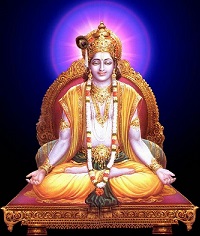
The term yoga refers to the union of individual soul (unit self) with the Supreme (Paramatma). The seers, the wise and the devotees of God incessantly try to attain the state of communion of their souls with the God, the Supreme consciousness. Those who try for the communion of soul by acquiring right knowledge of the Paramatma (Supreme) are called the Sankhya. Sri Krisna tries to reveal the secret of Sankhya yoga in this chapter. We are fortunate enough to know it through the discussions of Arjuna and Sri Krisna. The process of Jnana yoga, unveils the secrets of the most subtle realms of human mind and even beyond. It is true that the discussion is not mainly concerned with the message of war but of the deep inner realities and possibilities of the human mind.
The discussion is not only confined to mind but also of subtler realms, i.e. related to spirituality. The impending war acts only as a veil to the secrets being revealed. We can see through out this chapter that a Pandora’s Box of knowledge open. We shall approach it with utmost humbleness to get the hidden knowledge unveiled. SriKrisna opens his deep discussion on conscious realms, starting from this chapter onwards, like a beautiful lotus getting slowly bloomed into its perfect beauty and glory.
Sanjaya said: Sri Krisna asked Arjuna who was depressed, distressed, and very sad with tears filled in his eyes and in a helpless mood.
Why do you behave like a fool, not getting ready for the war, at this critical situation? It is not proper for a noble warrior like you and that it will neither bring heaven nor fame to you.
There is a saying that those who die in the battle for a good cause will attain heaven.
Arjuna, you being the scorcher of enemies it is unbecoming on your part. Therefore shake off weak heartedness, stand up and get ready for the fight.
Arjuna said: Krisna, how can I kill the most reverent persons like Bishma and Drona in the battle?
Bishma was the great grand uncle of Pandavas and Kauravas and Drona was the guru who taught the art of archery to both the Pandavas and the Kauravas.
Killing of parents or gurus remains a severe and lasting pain of man in the history of his civilization.
It is better to lead a life of a beggar than killing the noble elders and that it is meaningless to enjoy the blood stained pleasures of wealth and sensual enjoyments after killing great men. It seems a genuine argument.
I do not know which is preferable, to fight the war or not. It is not sure whether we will win or they. I have no desire to live killing the Kauravas arrayed to fight against us. Arjuna was in severe dilemma.
My mind is puzzled and I am not able to judge what is wrong and what is right. I am your disciple and find refuge in you, Krisna. You therefore kindly advise me which is decidedly better.
There is a practice among people approaching a guru to get the right advice at critical situations. But often they do not follow the advices that are against their material desires.
I do not think that my grief could be driven away, even by getting the rich kingdom on the earth or the lordship of Devas above.
Arujna’s mind was filled with severe grief on the possible consequence of the war ahead.
It is also true for a common man that his guilt will continue to haunt him torturing, till death. Even in a great Guru there exists a very common mind as well. Only a very few know this.
Sanjaya said to Drutarastra: Having expressed his pathetic condition to Krisna, Arjuna reiterated that “He would not fight and kept silence.”
Normally such a decision of a war cannot be changed on a sudden.
Sri Krisna has told the following, with a more or less insulting smile to Arjuna who was in the midest of worries and in a deeply depressed state.
You are in deep grief unnecessarily and speak like a learned man of wisdom. Wise men are not so sad over the dead or the living.
These types of excuses are common with many who withdraw themselves at the crucial point of time from an act putting the blame and burden on others.
Krisna said: You, I and the kings who gathered to fight here existed in the past and will continue to exist. Life does not cease forever by death.
Here, Sri Krisna reveals that birth and death will continue till one attains the ultimate state of liberation or moksha.
Rebirth is one of the central concepts of the Eastern philosophies. The Western philosophies do not have a clear concept in the matter.
The soul residing in the body is attributed to boyhood, youth and old age until the soul seeks another body after death for reincarnation or rebirth. No wise man becomes deluded by this.
Births and deaths go on repeatedly until the soul merges with the Supreme. So, one shall be ready for a better life, if not liberated, at the next birth.
Do good to others shedding egoism, arrogance and selfishness to get a better life, hereafter.
O son of Kunti, the dichotomic feelings of heat and cold, pleasure and pain etc. are due to the contact of senses with their objects of enjoyment. But these feelings are short lived. Better to ignore them. All pleasures and pains are transitory. Every beginning follows an end.
Krisna said; Arjuna, wise men do not bother for pleasure and pain and that they are not affected by the pair of opposites. Persons with equanimity only, shall become immortal.
It is not wise to remain in grief over the miseries or pains and to enthuse much over pleasures for they are transitory.
The unreal has no permanent existence and the real never becomes extinct. The real exists all the time and the unreal goes on changing its form.
The term ‘asad’ refers to the illusionary world. The ultimate truth is the same that exists for ever. It is nothing other than the Supreme.
The all-pervading entity only is imperishable and that nobody can destroy that entity.
God alone is the ultimate truth and the indestructible.
The soul, residing in the body, is imperishable and eternal. As the body is perishable, there is no need to worry over the body. Some think that they are long living though not imperishable. They do not and cannot think of their deaths till seriously bed ridden.
No one can kill the soul or the soul can be killed. Those who think so are fools. The atma is eternal and a part of the Supreme Being.
Atma (soul) has never taken birth or is dead. Only the ignorant thinks that the soul can be killed. It is eternal and without beginning or end. Nobody can kill the one without beginning or end. The atma is a temporary resident in our body.
Arjuna, if one knows that the soul is imprishable, eternal and free from birth and death, who can kill it or causes it to be killed? It shows that the soul cannot be killed which is eternal.
As if human beings cast away, the old clothes; the soul residing in human body leaves the worn out bodies and enters into new bodies.
Those who know the secret of dreams hold that changing of new dress is a symbol of rebirth or death. Thus rebirths continue till the soul gets liberation.
This is a clear deviation of the Eastern philosophy, from the Western. The Eastern is based on the concept of reincarnation. This concept was developed by many Eastern seers including Lord Buddha, as a result of their deep and long meditations on the Supreme and their experiences in spirituality.
Everybody’s life is a continuous journey until his soul merges with the Supreme. There is a message to all that we should lead a life fulfilling our moral obligations to ourselves and to the society.
The atma (soul) cannot be cut with weapon or burned by fire or wet by water or dried by wind.
It means that the soul is beyond the purview of the five fundamental elements; Akas (Ether), Vayu (Air), Agni (Fire), Jala (Water) and Bhoomi (Earth).
Atma being a small particle of the Supreme consciousness is not a part of power (Prakriti). It is further made clear that God is not power but the entity beyond the fundamental elements of power.
The Supreme is eternal (everlasting), omnipresent and immovable but the unit soul is under the bondage of the forces of Prakriti represented by one’s mind.
The soul is un-manifest and beyond the reach of our thoughts and is immutable. Therefore you need not be worried.
The soul, used here is to mean the Paramatma. The unit soul feels pleasures and pains as it is under the grip of the mind influenced by the subtle principles of Prakriti.
Arjuna, even when you think that the soul is subjected to death and rebirth why do you grieve in such a way? It is inevitable.
The arguments of Arjuna are not relevant and are the justifications of a coward. Any powerful man may be got puzzled while facing a more powerful person.
As death is inevitable for the living and rebirth for the dead, there is no need to worry over.
Arjuna tries to escape from performing his moral obligation of fighting the war against the Kauravas. Krisna gives apt answers to his questions and justifications.
We know that there are some, in the ordinary course of life, who are negative in nature and often argue very vehemently against performing a right action. Such people cannot do anything good to the society, though often they live at the expense of others.
Arjuna, the beginning of all beings is not clear and so is their future.
The present alone is clear to us and therefore it is meaningless to worry much over them.
We should know that the present before us, is clear and that we should perform all our duties only at the present. Some may blame one stating that he would have and should have done such and such acts or work in the past. It is a technique to stop other’s arguments. No one can go back to the past and correctly do a work again. The irony is that the person blaming others so, would not have been ready to give any suggestion at the time of doing the action in the past. Such blamers are evil minded, negative and sinners.
One may hear about atma (soul) anxiously and one may speak about it seriously. But none actually knows the atma (soul) properly.
The knowledge of many about the atma is like the knowledge of the blind men explaining of the elephant they meet. The knowledge of the Supreme will never end. There is limitation to the human mind.
Arjuna, why do you worry even after knowing that the soul residing in man cannot be slain?
The soul in everybody is the same, but the mind and the body differ. There is no body identical to another body, so is the mind.
There is nothing superior to one’s own moral obligations (dharma). The moral obligation of Ksatriya is to fight for a right cause.
Everybody must perform their moral obligations assigned to them. Those who do not perform their duty or run away from doing it, are sinners.
Arjuna, war against evil is morally obliged and that it takes place only very rarely. Waging war against evil forces opens the gate way to heaven, for the Kshetriyas who die in the battle.
This concept is practically good for it would act as an inspiration to the soldiers. We respect them earnestly on their death though none knows where their souls would go on leaving the body.
If you do not perform your moral obligation by fighting in the impending war, your fame will be lost as one who is not doing his duty and that you shall fall into sins.
Everybody is destined to perform his moral duty inevitably. He who does not do his duty will be branded as sinners.
Others will carefully watch the loss of your fame. The ignominy (defamation) of a person, enjoying fame is worse than death.
We know that everyone doing wrong deeds is very particular for not it be known by others. It is very severe for a gentlemen falling victim of scandals which affect his good reputation. He may even commit suicide.
There are some who consider scandals as a credit. They are very grave sinners.
The enemy warrior chiefs may think that you manage to run away from the war field due to fear. You should know that they are who recognized you as a great warrior and that they would realize your real inner status on leaving the war field.
It is not desirable for anybody going away from performing his duty. Idle men often find excuses and keep aloof from doing their duties. However they are very eager to blame and find fault with others doing their right duties.
The psychology of the idle is to find fault with, those doing their duties.
Your enemies will talk disparaging and unbecoming words against you. They would enjoy insulting you as well. What shall be more distressing than this?
For a gentle and dignified person, defamation is very serious and injurious to him. There are some trying to insult others though they cannot withstand insult on them. It is stated that a king can insult anybody but he cannot bear an insult on
him. Our present political leaders are example of old kings who enjoyed luxuries of life.
Arjuna, if you die in the war you will attain heaven but if you win the war you can enjoy kingly pleasures. Therefore, you shall stand up and get ready to fight.
Though Viraswarga is a hypothesis, kingly pleasures are real.
You get ready for the fight, treating pleasure and pain, benefits and loss, victory and failure equally and that you will not be affected by the influence of sins.
The dichotomy of the opposites prevents one from going ahead in life. If we are bothered about the dualities we will not succeed in life.
Arjuna, the attitudes of mind are discussed in Sankhya yoga (yoga of right knowledge). Now you may hear from Me about Karma yoga (yoga of right action).If you perform your duties well knowing the principles of Karma yoga you will not be affected by the sins of action.
Having revealed the secrets of right knowledge, Krisna makes Arjuna aware of Karma yoga. For some Jnana yoga is not desirable. They may not have patience to know some thing deeply but they may be very much interested in performing their duties. For such persons Karma yoga is more suitable and acceptable.
We get the knowledge of different yoga methods through the discussion between Arjuna and Sri Krisna as given in Bagavad Gita by the great seer Vedavyasa.
In Karma yoga (Yoga of right action) nobody loses anything. There will not be any opposite results too. But even a little practice would save the doer from the terrible fear of death and birth.
The duty of everybody is to perform his work properly. There shall not be any ill effect of the bondage created by action. The better way to save one self from the attachment of actions is Karma yoga. An action is evaluated on the basis of its influence on or bondage to the soul. An action not bringing bondage to the atma is good and wise. It is not desirable to do an action binding the soul under the bondage of attachment.
Arjuna, by practicing this yoga(Karma yoga) one’s intellect would become stable and directed towards the great ideal of the Supreme. The intellect of the indeterminate person is like a tree with innumerable branches, generating endless thoughts and discomforts.
When one is keen in the right action, his mind becomes determinate and strong enough to be directed towards the Supreme.
Arjuna, most of the people strongly desire for mundane pleasures and happiness only. They insist only on the letters of the Vedic literature and perform rituals accordingly. Their ultimate goal is heaven as they know that heaven is the embodiment of pleasures and sensual enjoyments. They shall speak in attractive languages very beautifully though they aspire only for power and pleasure. They wish that the fruits of their action should follow them even in their next birth too, in the form of sensual pleasures. It is their prayer.
Many are very eager to conduct temple worships and secret worships at their homes. But they will never have their determinate mind fixed on God, the Supreme.
We see that most of the devotees of God do worship Him to get worldly pleasures. They do not want to attain the divine God but his bounteous prosperities. They worship at temples and homes for acquiring wealth and pleasures. Such worships are not spiritual and not related to the Supreme consciousness. Spirit refers to the ultimate truth, the God.
Worship is therefore, said to be spiritual only if it is performed for the attainment of the Divine.
Arjuna, know that Vedas deal in detail of the influence of the operative principles of Prakriti. You should remain firm in Sattvaguna (sentient force) and do your duty without insisting on the fruits of your action (Niskama Karma). You may try to know the ultimate truth beyond pleasure and pain and be non-dichotomic and that your intention shall not be to maintain the pleasures at your disposal. ‘Yoga kshema’ refers to safe guarding and retaining of the pleasures one enjoys at present and those expected in future. It is difficult to escape from the pit of dichotomy once fallen into it. But when equanimity is established in one’s self, he would essentially march towards the ultimate goal of the all Loving, the all Pervading and the Divine entity.
For an individual, when everywhere is filled with water; small reservoir like wells and ponds will have no particular use of water. In the same way, for an enlightened soul, all Vedas are of the same use.
For an evolved soul immersed in the light of knowledge of the Supreme, no special purpose is served by the Vedas or any other scriptures. He is one already attained the ultimate truth.
You have the right only to do your duty, and have no right to the fruit or result of action. You shall not be instrumental to making your action fruit bearing or shall not have attachment to inaction either.
Action and fruit of action are different. Fruit is the resultant effect of an action. All actions with the sole aim of fruits make one so selfish and that his mind becomes impure. It should be borne in mind that an action requires many other factors also to get the fruits. If a person is cultivating his land, water, sun light, manures etc. are required to get the harvest. In the same way work is only one of the factors for getting the fruits of action. One should not remain without doing his right duty.
Therefore Dhananjaya, you shall perform all your duties, establishing yourself in the state of yoga, without attachment and with equanimity of mind in success or failure. Equanimity leads to yoga.
Perfect balance of mind is yoga ‘Samathvam’ refers to one’s equal feeling in pleasures and pains.
Performing one’s duty for selfish interest is inferior to Budhi yoga(Karma yoga), the Yoga of right action. A person performing his duty with the motive of fruits is an inferior being. Do your duties with equanimity of mind.
Performing ones duty without aiming for results shall make him a ‘Karma yogi’. That is, doing his duties without attachment to the fruits will lead him in realising the Supreme.
One with equanimity of mind only, can shed off the bondages of good and evil actions. Therefore, you strive to practice yoga of equanimity, evenness of mind. Yoga is the result of cleverness of the skillful action. Yoga needs equipoise of mind and skill in performing the right practice.
Those wise men with equipoised mental status, renouncing the fruits of action escape from the bondage of further birth, attain the blissful state of the Supreme.
Equipoise of mind and detachment to the fruits of action help one for saving himself from the clutches of birth and death and to take him to the state of lasting peace or Ananda. In short one should (mentally) become totally free. Complete freedom of soul is liberation.
When your mind is freed from the delusion of ignorance you will develop indifference to the mundane enjoyments and also from what is heard or to be heard.
Delusion, is the attraction towards worldly pleasures acting as a veil to the truth. Those who think that the veil is truth, cannot go beyond ignorance.
When your intellect gets freedom and rest from hearing the confusing statements and remains undistracted on meditating upon the Supreme, you will attain the state of union with the Supreme.
Equipoise of mind is a prerequisite for meditating upon God and His realization. A distracted intellect is not at rest enough, enabling to meditate upon the Supreme.
Arjuna asked: Krisna, what is the nature and identity of a realized soul who has a stable mind and who has established in perfect tranquility of mind? How does the man with stable mind speak? How does he sit? How does he move (walk)?
Arjuna wanted to know the peculiar nature and identity of a realized soul.
Sri Krisna said: Arjuna, he who shuns sensual pleasures and finds happiness in his soul is one stable minded.
Human mind is a conglomeration of various thoughts of worldly desires and pleasures. When one can dispense with such pleasures or at least remain unattached internally, his mind shall become stable and qualified to meditate upon the Supreme and to derive spiritual gain and happiness.
He who remains undisturbed in the midst of miseries or sorrows and his craving for worldly pleasures has disappeared and is one free from the feelings of passion, fear and anger and often remains silent; can be called a stable minded one.
A stable minded person is not affected by overwhelming emotions. He remains silent and unattached.
He who remains unattached to the favorable and unfavorable results, who neither rejoices nor hates while meeting with good and evil; such a person’s mind is said to be stable.
If a person’s mind is stable in the thought of God he will be steady and remain unattached with worldly pleasures or pains. He has already established equipoise of his mind. A balanced state of mind is really stable.
When one withdraws his sensory organs from the sources of worldly pleasure, as if a tortoise that draws back its limbs from all directions; his mind is said to be stable.
Pleasure is felt in one’s mind on enjoying different sense objects. Enjoyment is an internal affair so is pain. If one gets immense pleasure or bliss by mediating upon God, his desires for worldly pleasures and craving for the objects of enjoyment would subside. It is not the use of objects but the attitude towards them is counted. A stable minded person established in the spiritual pursuit feels that worldly pleasures are much inferior to the tranquility and bliss he experiences on meditating upon the Supreme. He who is after worldly pleasures can not experience the treasure of happiness of his soul.
When a person observes complete fasting and gives up food, his sense organs may withdraw their functions temporarily. But the craving for sensual pleasures will remain active in his mind. However, when a stable minded person realizes the Supreme, all his desires for worldly pleasures would disappear forthwith.
The enjoyment or bliss one derives on realizing God is infinite, immeasurable and fabulous. There is no comparison of it with the silly sources of worldly enjoyments.
The fact is that even in the case of a person striving to control his senses, the blind sensory organs may forcefully carry him away.
It is very difficult to control one’s sensory organs; but possible. It calls for one’s earnest effort of shunning of arrogance and the grace of God or a great Guru.
He who meditates upon God controlling his senses can attain the state of stable mindedness. Normally the sensory organs move towards its objects of enjoyment and bring disturbance to one’s mind. But only when one is able to control his senses and mind, is said to be stable.
An unstable mind driven away by senses is not suited for meditating upon the Supreme.
He who has attachment to sensory objects and is trying to acquire such objects of enjoyment develops lust over sensual pleasures and objects. When one’s desires are not satisfied he becomes angry.
We know that if a person who eagerly desires to acquire something and finds that there are some obstacles to get it, he would normally become angry. Psychologically anger arises where one’s desire could not be satisfied.
As a result of anger one develops infatuation (samogha). Infatuation causes confusion in the memory leading to the loss of reasoning and then to complete ruin.
It is true that anger may lose the balance of mind of an individual. When a person is overcome by anger, he speaks forgetting all his relations. He may use very crude, unrefined, abusing and insulting words on others thinking that all are his opponents. Anger is a psychological illness. It is to be noted that he who becomes seriously angry every now and then and if his anger lasts for a longer time, he is on the verge of a total mental disorder.
He who could win over his likes and dislikes and has control over sensory organs, and that even if he enjoys sensory pleasures, his internal peace and happiness will not be affected by the bondage of material enjoyment. He is a man without likes and dislikes.
Sensual enjoyment is not a sin as such, but if it is uncontrolled, the individual easily becomes a victim of sins. Everything should be under proper control.
When a person attains placidity(peacefulness) of mind, all his sorrows cease to exist. Internal happiness will become stable on the divine thoughts of the God.
‘Manaprasada’ is placidity of mind that helps for the attainment of God.
If a person does his work with happiness and contentment, he can definitely speed up the process of attaining the Supreme. Discontentment reduces the efficiency in work. But for a person, with constant interest and sincerity in his work increases his capacity continuously.
Perform all actions with contentment and keep up placidity of mind.
How, a person who has no control on his mind and senses or with undisciplined mind, can think of God?
A person is said to be civilized or cultured only to the extent to which he has control over his instincts and consequent emotions.
He who acts only according to the influence of his sensory organs, is like a boat moving in the water at the direction of the wind.
Many become criminals as they have no control over their minds and as they act instinctively. The instinctive part of the human mind is very crude and needs refinement, if not they may become animal like.
Punishment given to criminals would be for the refinement of their instincts, or otherwise they would become more severe criminals after they are released from jails.
Therefore Arjuna, one who draws back his mind from sensual enjoyments, his intellect will be stable and established in God.
No one can live without sensory organs. But uncontrolled sensory organs keep him away from God.
For those what is ignorance, night or darkness it is light or knowledge for the stable minded one.
A man who has control over his senses remains awake and conscious in the world, considered as ignorance by others. The mundane world where all the creatures remain awake is equal to night or ignorance to a stable minded person.
The meaning is that what is real to the ordinary men and animals is not real to a ‘Samnysasin’ or self-controlled individual. It is a world of miseries to him. But for a man with uncontrolled mind, the mundane world is only the real and the world above is unreal and unknown to him. For a stable minded man, established in the thoughts of God, the worldly life is painful and equal to hell. His prayer is to deliver him from the worldly pains and miseries.
A stable minded person moves from darkness to light (ignorance to knowledge) where as an unstable or ignorant one moves from darkness to darkness (ignorance to ignorance).
As waters from the overflowing rivers merge with the sea, a person with stable mind, who has established his thoughts on the Supreme, all his desires merge into a state of complete peacefulness on the constant thought of the Supreme.
In the case of a person who is able to surrender himself to the Supreme, gets all his thoughts and desires merged and dissolved in the divine state of bliss.
He who moves towards God detached shunning all desires, egoism, the feeling of mineness and the thirst for sensual enjoyment will invariably attain the state of ultimate peace or bliss.
Egoism and arrogance act as the main hindrance to the spiritual progress of an individual. When arrogance subsides there develops humbleness.
Only a humble person is eligible for the realization of God. He who is devoid of humbleness is equal to animal. When animosity is sublimated the result is humbleness.
Develop humbleness and become eligible for the realization of the Divine consciousness, the Purusa.
Arjuna, a God realized person overcomes all his delusions and attains the highest state of peacefulness.
He becomes peaceful even at the time of his death. Everybody wants peace of mind. But One has to control his mind and try to fix his thoughts on God. Unfortunately most of the people are moving on the way of unrest, knowingly or unknowingly. Thus one tortures his own soul making it difficult to attain the peaceful state of mind. The state of peacefulness or bliss is far superior to all sense enjoyments.