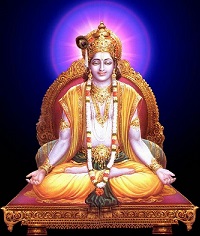
Ksetra refers to a particular realm or plane (Mandalam). It is to be
understood as a place of worship. He who knows about Ksetra is Ksetrajna. Many
of us conduct our worship in temples where images (idols) of Gods are
consecrated for worship. Some worship their selected images of Gods in private
prayer rooms at their homes. Some others worship God chanting His name always
secretly. The ultimate goal for every method of worshipping God is to attain Him.
But many worship God for their material benefits. They get it too, but not God.
In this chapter it is discussed about Ksetra, Ksetrajna and about the
presence of God in the worshippers etc.
Make your body a clean temple, with utmost purity and worship God with due
devotion.
Arjuna prayed Krisna to tell him about Prakriti, Purusa, Ksetra, Ksetrajna, Jnana, Jneyam etc.
Krisna said: Arjuna, this body is to be understood as Ksetra and that according to the seers, he who knows about Ksetra is Kshtrajna. The true place of worship is one’s own body. Therefore one’s body must be kept pure and suitable for the worship. It is in the body where the soul being the practice of the Supreme resides. The aim of worship is to free the soul form the body and mind. The soul is under the strong bond of body and mind. Unless the mind is purified the bondages cannot be removed and the soul relieved. Purity of mind shall be followed by the purity of the body to do proper worship. It is said that when a person with purity of mind worships with devotion of the Supreme, he will be relieved from the worldly miseries, in due course. Really everyone is the priest in the temple of his body where the deity is the soul, representing the Supreme.
O Bharatha (Arjuna)’, I myself resides in everybody as his soul. Real knowledge is related to Ksetra (body) and Ksetrajna(soul).
I shall explain you in brief as to what is Ksetra? How is it like? What are its attributes? What is the glory of Ksetrajna etc.You hear from Me.
The great seers have explained in detail the Ksetra and the Ksetrajna in their own ways. It is available in various Vedas and is well explained in Brahma sutras.
The five fundamental elements ether, air, fire, water and earth; the intellect, ego, the manifest primordial Prakriti , five sensory and five motor organs and the mind; the five objects of senses; desires, hatred, happiness, sorrow and the body consisting of the senses and the soul all together is termed as Ksetra. The sensory and motor organs, atma and the body consisting of five fundamental elements and the human instincts and intellect; all represent or form the Ksetra. The same concept and principles are followed in the case of temples being used as the place of worship. One is in and the other is out. The human body is said to be a miniature form of the universe.
The qualities of Ksetrajna are the absence of pride and hypocrisy, patience, observing of non-violence, forgiving, straight forwardness in speech, devout services to the Guru, steadfastness, internal and external purity, cleanliness etc.
Ksetrajna would be a person without sensual desires not anxious to birth, death, old age, diseases etc.; having no feeling of minenes to children, wife, home and is with full devotion to Me. He must reside in secluded and holy places and not in the company of others. He must be confident in the knowledge of atma knowing that the Supreme self is the origin of true knowledge. He must know that only by the knowledge of the Truth one can attain liberation.
I shall explain in detail the truth you should know. Those who know this truth will attain the state of infinite happiness (bliss). It is the Supreme truth of Parabrahma, the Lord of the universe without beginning and end. Brahma alone is the cause of knowledge, consciousness and bliss.
As Brahma is all pervading it is said that it has hands and feet on all sides; eyes, ears, head and mouth in all directions. It does not mean God has many hands and legs. It is Omnipresent, Omnipotent and Omniscient.
Though it knows everything it is devoid of sense organs and unattached. It is the sustainer of all and the enjoyer of all the qualities of Prakriti.
Paramatma, the Supreme self, exists in and outside of all beings. It is the most subtle principle of the universe. Therefore it exists everywhere, though we do not know it at all.It is the spirit(satta) of everything. God is there, in all living and non-living things. He functions as the sustainer of the world as Vishnu; as the destroyer of the world, Rudra and as the creator Brahma. Brahma is the great light and is the cause of all lights. The light of Brahma (supreme) is beyond the principles of maya (Prakriti).
One must know that Purusa (consciousness) and Prakriti (power) are beginningless. Everything is created by the influence of three gunas (forces of Prakriti). Thoughts and emotions are formed due to the influence of the forces of prakriti. Since Purusa and Prakriti are beginningless the question of their origin does not arise.
Prakriti is said to be the cause of creation. But Purusa (the individual soul) is said to be the cause of enjoyement of happiness and sorrow. Though Prakriti is the combination of the three forces; Sattva, raja and tama; there is no I feeling to Prakriti. The ‘I’ feeling is due to the consciousness (soul) present. Therefore the enjoyer of happiness and sorrow, causing bondages is the soul. Everybody is actually torturing his soul by enjoyments and sorrows, forming bondages.
The Purusa under the influence of Prakriti enjoys happiness or sorrow being created by the bondages of Prakriti. Where bondages are many the soul suffers a lot and where it is less the soul feels relief to that extent. The forces of Prakriti (the gunas) in one are responsible for the good and evil births of the soul.
The soul is the spirit dwelling in the body representing the Divine supreme entity, as stated by great seers. But it is controlled by the mind as influenced by the forces of Prakriti. It is the witnessing entity in everybody and is the cause of the unified action of the body.
A yogi who truly knows Purusa and Prakriti, will not be affected by the bondages of Prakriti and that the right actions performed by him shall make him immortal without further birth.
Some try to see the Paramatma, the Supreme in his heart by their purified intellect and meditation; some by way of true knowledge and some by performing right action taking the ideation of the Divine.
Some others, without following the three methods; knowledge, meditation and right action, hearing from gurus (teachers) and attending the principles of spirituality carefully worshipping the Supreme will also be delivered from the tortures of births and deaths. There are many who do not know about Jnanayoga, Karmayoga, Dhyana yoga etc. but as advised by Sadgurus, they practice worshipping God. They also attain the Supreme. But often people are misguided by pseudo gurus. As a result the worshippers may face many a problem.
Arjuna, you shall know that movables and immovable are created by the union of the Ksetra and Ksetrajna.
He who sees equally the Supreme consciousness existing in the perishables living and non-living things; as imperishable is really a spiritual aspirant or yogi. In everybody (perishable) the imperishable soul exists. It is called the unit self or jivatma. At the time of death the mind carries with it the soul under its bondage and causes to births until the soul reaching the Supreme.
One who sees the Supreme equally in everything shall not kill himself. Those who realize the existence of Supreme consciousness everywhere, attain Him in due course. They cannot reject the Supreme self and the unit soul.
He who knows that all actions are performed according to the influence of Prakriti and that soul does not do anything really knows the truth. All actions are taken place according to the influence of Prakriti acting in one (Sattva, raja and tama-gunas) and that the jivatma has no role.
When one realizes that the original basis of all beings is the Supreme consciousness and that the whole universe is emanated from Him, he attains perfection and merges into the Supreme, shaking of all bondages, caused by the actions under the influence of the natural forces.
Arjuna, though Paramatma exists in every being along with the principle of Prakriti, He does not do anything and not create any attachment or bondage due to action. Nobody can pollute or make Brahma impure, as he is beyond the principles of Prakriti though the unit soul is tortured by the mind due to the influence of the forces of Prakriti.
The Supreme light of Paramatma, though exists in everything, it is so subtle and pure and cannot be mixed up with anything. It is not related to bodily actions. 215 The Supreme entity is all-pervading and hence it is subtler than the subtle and that nothing can influence Him. The irony is that the Supreme entity in the form of unit self (soul) suffers the pains and enjoys pleasures as being enslaved by the mind.
As the sun lightens up the entire world, the ksetrajna brightens the whole universe (ksetras). Here Ksetrajna is considered as Paramatma which is also called Suryanarayana, the cause of all lights, existing and spreading His light everywhere.
One who is able to know the difference between Ksetra and Ksetrajna by his invisible eye of knowledge reaches the Supreme. The aim of every soul is to attain total freedom and there by to reach the Supreme self